Showing posts with label Recycling. Show all posts

Tuesday, 8 November 2011

SUSTAINABE GARDENS OPEN DAY 2011 - NEWPORT AND ALTONA, VICTORIA


Sustainable Gardening Australia
    November 2011


Werribee Open Range Zoo together with Sustainable Gardening Australia

presents  

Sustainable Gardens Open Day 2011

Newport and Altona

Sunday November 13th, Open 1pm to 4pm
Sustainable, productive, inspirational, achievable!
These gardens are wonderful examples of gardening sustainably, producing fresh food in your own backyard, working with recycled materials, and maximising productivity through organic means. 
Kate's garden and Mara's garden will be open for viewing from 1-4pm on Sunday November 13th.  Entry is by gold coin donation and all proceeds will go to Werribee Open Range Zoo.  


Kate's Garden


Kate's garden begins with a simplified food forest in the front yard, with fruit trees including plum, nectarine, cherry, almond, apple and pear.  The rear yard is still in transition, yet features many sustainable design elements including a green house, chickens, compost and worm farm.  The eastern half is becoming a perennial edible and medicinal garden, whilst the western half is dedicated to vegie growing.   Kate has recently added a bee hive to the garden also.  Kate's inspirations in the garden centre around growing fresh food including a growing interest in growing nutrient dense food.  Kate's garden is a great example of maximising the average backyard space to create a garden for food security based on sustainable principles.   
Kate's Garden is at 10 Rivers Street, Newport


Mara's Garden


Mara has dedicated the last two years to nurturing her 500m sq house block into a productive food forest.    The basic design is now complete, but many new projects are still planned or in progress.  The garden has many sustainable features such as compost stations, worm farming, and an orchard that includes figs, plums and banana.  Some of the more unusual features of Mara's garden are the very creative use of pickle barrels for water collection and berries grown in crates built from recycled materials.    Mara's garden demonstrates what can be achieved with recycled materials and a little imagination.  Her garden is productive, achievable and will inspire in its use of sustainable principals and recycled materials.  
Mara's Garden is at 106 Railway Street South, Altona

For further information contact SGA on 8850 3050,  

Saturday, 4 June 2011

#ShabbyVintageJunk Extravaganza now on! #recycling #sustainability

Amplify


As I write, doors have been open at the Ashburton Scout hall below on the second and final day of the wonderful Shabby Vintage Junk Extravaganza 2011. If you haven't been yet, hie thee over there post-haste. Beautiful stuff there.

Congratulations to the marvellous Tamara who organizes the Extravaganzas and top marks to all the women who bring their wares to make this a marvellous showcase of a very feminine economy. Many of the women from SVJ Extravaganza 2010 are there - and they have stepped up their skills quite a few notches and gone into areas that weren't seen last year. Many of the women are new. They came as shoppers last year and are here as stallholders this year.This adds new zest and wider offerings to Tamara's wonderful plan. 

The USA has many huge, wonderful events in this genre and the Ashburton Scout Hall is a teensy-weensy venue by comparison. But, compared to the USA market, Oz is a teensy-weensy ant to begin with. If Melbourne and Victoria can support the Shabby Vintage Junk Extravaganza, perhaps Tamara's business plan will be the seed of something large which will transform the recycled goods sector and involve the women who have seeded Tamara's vision in a huge economic step into a more sustainable lifestyle.

What you get at SVJ is not 'Made in China'. You can rest assured that the exploitation that has occurred in putting this together has been from the women themselves - who have worked long hours and burned the midnight oil to have such excellent products available to the public. And I don't think any rainforests have been denuded in the process. My only concern might be for the paint products used along the way - but not everyone bothers to paint, because rust is a well-beloved feature.

So hie thee hither

Thursday, 2 June 2011

Shabby #Vintage Junk Extravaganza 3-4 June 2011 #recycling #sustainability

Amplify


This is the second year that the Shabby Vintage Junk Extravaganza has been held. The leadership for this event is provided by the indefatigable Tamara.  Many of the favourites from last year will be there again this year along with some new participants.  

Please let me declare my interest.  My daughter, Herself, was one of last year's participants and will be there again this year. She has masses of stuff to offer.  See one of her collages below.  And there is the most charming old-fashioned rocking horse.  

To find out more about last year's wonderful Extravaganza, please go to one of my other blogs, The Trad Pad.  

Please note: this year there are Early Bird Tickets.  This gets you in for a special one hour of shopping prior to the main opening time.  It is the Early Bird who truly catches the worm, so if you pay for that premium ticket you will get the premium pick.  I do know though that the stall-holders have so much stuff that stalls won't be emptied by 1pm.  

Friday, 20 August 2010

Shabby Vintage Junk Extravaganza: how a suburban scout hall was transformed with fluffy white paper balls and very creative stalls

Last week, I posted about the Shabby Vintage Junk Extravaganza in which a suburban scout hall was transformed with hundreds of white fluffy paper balls and the ingenuity and creativity of a dozen women into a sustainability sale of shabby chic, vintage, junk, recycled, re-jigged and re-purposed collectibles.  Superhuman effort went into this - mainly by Tamara and her resourceful husband, Matt.  They were the sustaining dynamos behind the SVJ Extravaganza.  Tamara and Matt have now posted some videos on You Tube which I have re-posted over at The Trad Pad.

Saturday, 14 August 2010

SHABBY VINTAGE JUNK EXTRAVAGANZA - DAY ONE

Day one at the Shabby Vintage Junk Extravaganza
was fun for everyone
even those who Top Gear tested the rocker.

Time Worn Style and The Pink Poodle have each posted.

It was busy, busy, busy from the time the doors opened to all the expectant customers queued outside.  Good trading, good conversation was the name of the game from 8am to 5pm and it is expected to be the same today from 8am to 3pm.  Much restocking to be done this morning before opening to fill the gaping holes left by yesterday's trade - so there will be fresh items waiting for perusal this morning!


Thursday, 12 August 2010

RE-JIG, RE-USE, RE-CYCLE BEAUTIFULLY: SHABBY VINTAGE JUNK EXTRAVAGANZA 13-14 AUGUST 2010 - #2

Yesterday, Networkers, 
I told you about the Shabby Vintage Junk Extravaganza.  
Well, to-day was move-in day.


Don't ask me if Tamara (who is organising all this) and her dearly beloved Matt slept last night.  I know that Herself was over there until well after midnight helping put up wonderful white tissue paper balls on the rafters of the Ashburton Scout Hut in High Street Road, Ashburton.  The Scout Hut is still a Scout Hut but now it is a Scout Hut with pizzaz and quite a large helping of swish.

To-day, I saw wonderful stuff being unpacked and displayed.
There are ten stalls but a cornucopia of variety.
Shabby is there in spades
with all that would gladden Rachel Ashwell's heart.
Vintage and retro is there in all shapes and colours.
Wonderful linens and handcrafted stuff -
that would delight not only the modern woman
but her mum and grandma - are all over.
And junk is there as its glorious self
and re-jigged in marvellously creative ways.
Talk about re-jig, re-use, recycle.


And for those of you who love your food,
I have singled out for special attention
Mrs Beeton's Cookbook
which comes complete with
handwritten recipes and etcetereas.
Just look...


So please come to-morrow and Saturday.
8am until 5pm Friday
8am until about 3pm or so on Saturday.
There are not many opportunities like this to purchase
from a multiplicy of specialist stall holders.
Please ecourage the efforts of 

Shelley, Andrea, Robyn,
Callee, Jane & Kaz 

See you when you are shabby shopping 
at the Shabby Vintage Junk Extravaganza

Wednesday, 11 August 2010

RE-JIG, RE-USE, RE-CYCLE BEAUTIFULLY: SHABBY VINTAGE JUNK EXTRAVAGANZA 13-14 AUGUST 2010

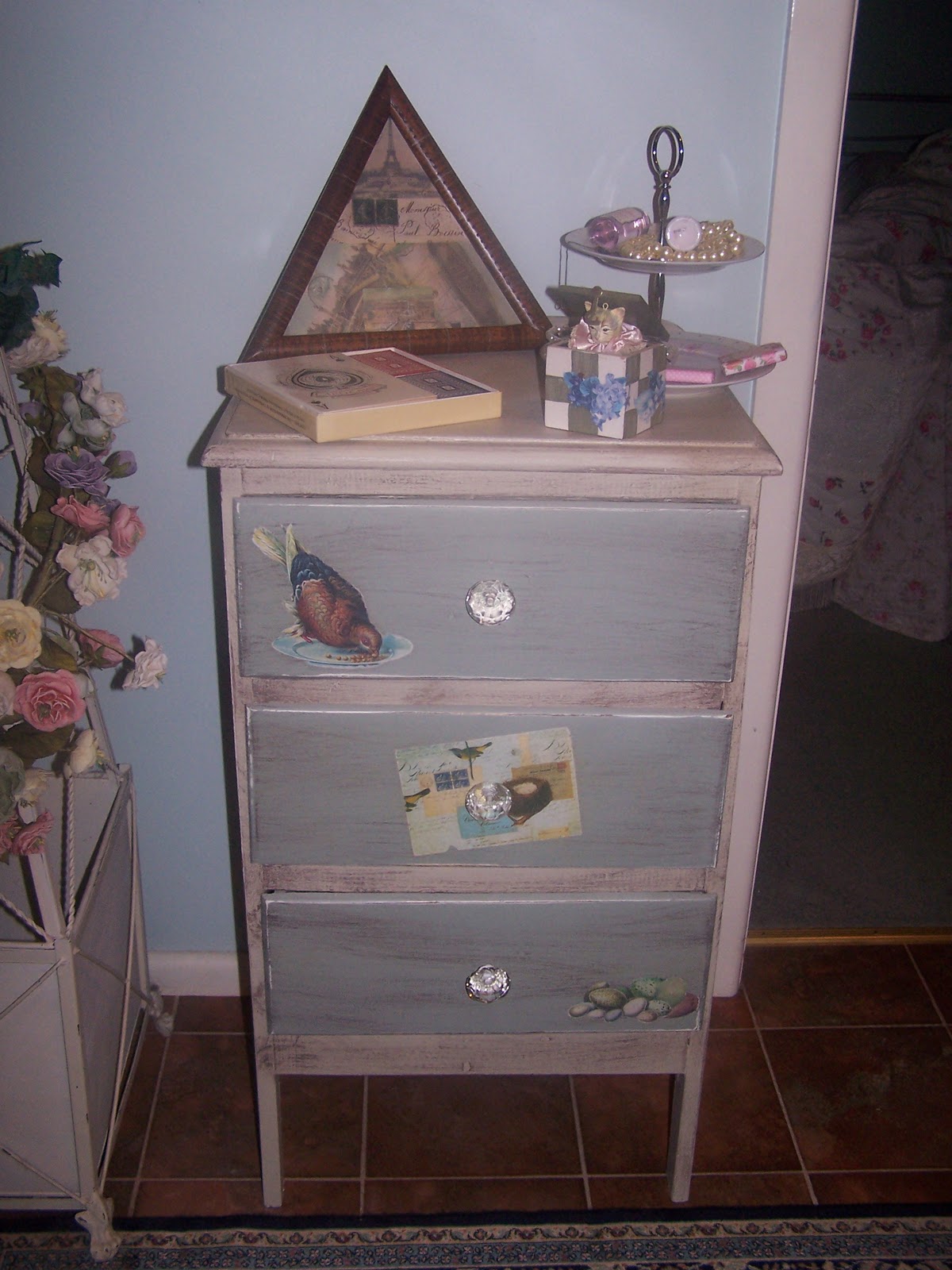
At our house there is always a lot of re-use, re-jigging, re-cycling going on.  My daughter, Herself, grew up with a mum who was always collecting and re-furbishing all sorts of things aided abetted by a very resourceful father who could work miracles from nothing much at all.  In fact, he was rather terrified about what would come home next from an auction sale....as if he should have talked because he was a champion gleaner and hoarder!

Anyway this is a lead in to tell you, Networkers, about the Shabby Vintage Junk Extravaganza on this coming weekend at the Ashburton Scout Hall in the eastern suburbs of Melbourne.  It has been organised by the redoubtable and indefatigable (don't you luv the way these words sound as they trip off the tongue) Tamara and she is all talk about it over at her blog, Shabby Vintage Junk.

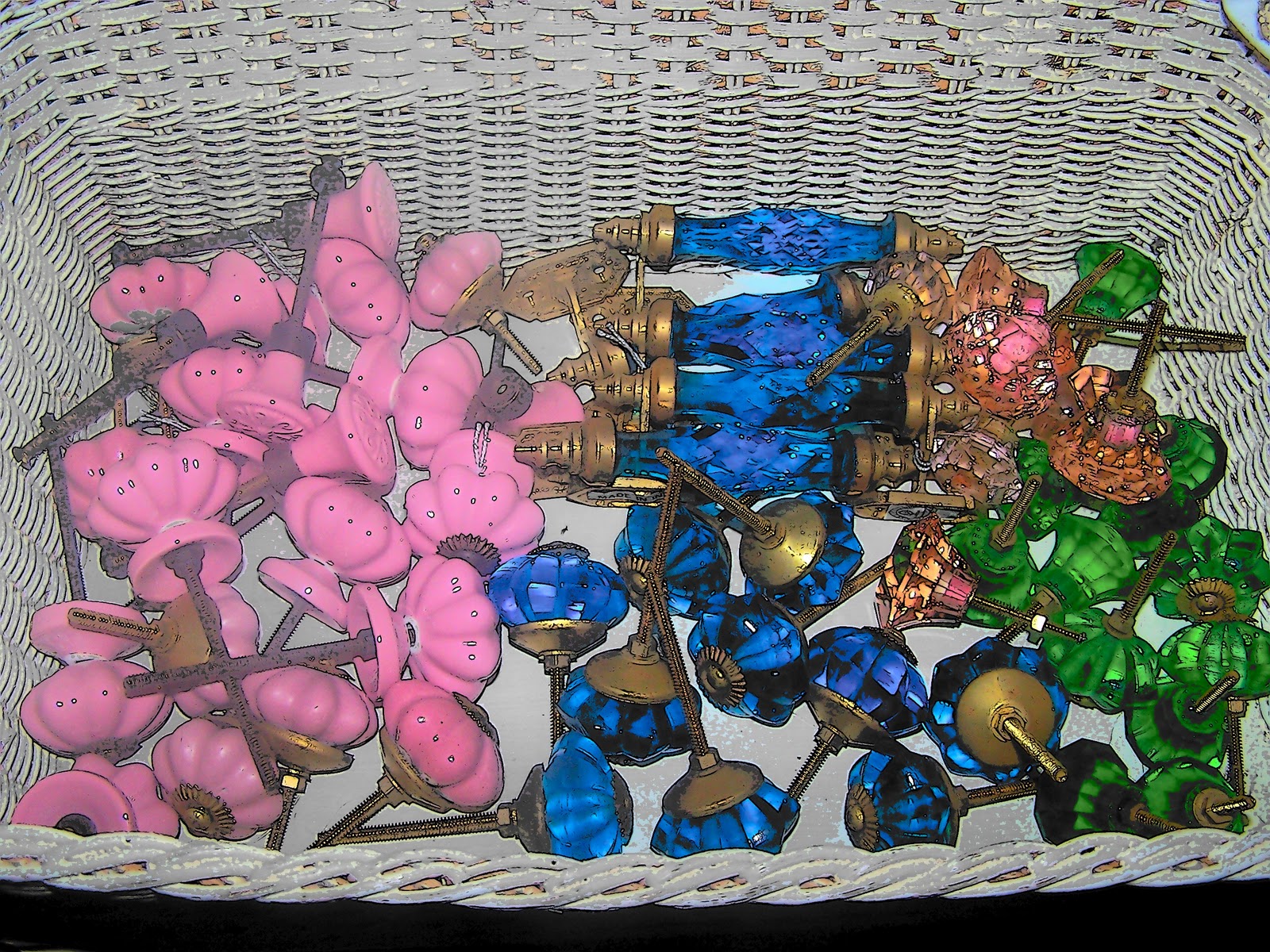
Things are on the go here as Herself has been organising for SVJ since way back when.  And things will still be on the go, I reckon, until the last possible minute.  The handles and knobs above will be there. As will some of the stuff below.
One whole living room is jam packed with stuff and has been for quite a while.
But my guess is Herself will be coming down to the wire
with some things......

See you there Friday and Saturday!
Enhanced by Zemanta

Monday, 17 August 2009

Fraser Brindley and the Good Fairy: take part in making an e-waste wish come true

No, I don't think that inveterate Networker,
Fraser Brindley of Environment Victoria,
thinks we should do nothing about our e-waste
and leave it to the Good Fairy.
Not at all.

Here's what Fraser's talking about.
Read below and then join in the campaign.
Then Fraser's wish will come true
and we can all join in with the Good Fairy
and know we are doing the right & responsible thing.

Dear Miss Eagle

A couple of months ago you sent an email to Peter Garrett and to your state environment minister to let them know that you want to see e-waste recycling in Australia.

Thanks for that. As a result of your action, we’re one step closer to getting an e-waste recycling scheme up and going.

As you might have heard, government has decided to release a consultation regulatory impact statement (RIS) for televisions and computers. This is a process to decide what sort of recycling scheme to introduce for televisions and computers.

We’ve posted our submission to this process. In summary, we’re asking for the federal and state government to do the following things:

- Introduce a single, nationally administered scheme for televisions and computers.

- Design the scheme so that it can be easily expanded to include all other e-waste, including mobile phones, batteries and fluorescent lights.

- Include all historic and orphan (obsolete brands) waste in the scheme so that everyone can recycle their old TVs and computers.

- Aim to achieve the highest possible rate of recycling.

- Make a decision this November when the Environment Protection and Heritage Council next meet.

If you agree with what we’ve had to say, please, let government know. The more people supporting our submission, the more likely we are to get e-waste recycling introduced and in a way that works for everyone.

Feel free to cut and paste the points above, and send your comments to:

Ms Monina Gilbey
NEPC Service Corporation
Level 5, 81 Flinders Street, Adelaide SA 5000
Telephone: (08) 8419 1200
Email: mgilbey@ephc.gov.au

Thanks again,

Fraser Brindley, Production & Consumption Campaigner

Environment Victoria

Our submission: http://www.envict.org.au/file/file/BA%20-%20EPHC%20consultation%20Regulatory%20Impact%20Statement%20for%20Televisions%20and%20Computers.pdf

The draft RIS: http://www.ephc.gov.au/taxonomy/term/51


MissEagle
racism-free
Photobucket

Friday, 7 August 2009

Simplicity - it really works better than desalination


Wannon Water down Warrnambool way believes it has an Australian first. In a new housing development, it is taking water directly from rooves into the water system without it being diverted through drains, etc. How simple is that?

Of course, there is a question mark. Isn't there always? It decreases the amount of water going into the soil. Our soil - unconcreted, unpaved, unbuilt - is the best reservoir we have. We must always raise questions when water is diverted from it.

Now can we have that replicated and retrofitted everywhere so that we can postpone the need for desalination.


MissEagle
racism-free
Photobucket

Thursday, 30 July 2009

Will desalination bring on the Hard Rain?

Click to enlarge

Victorian Premier, John Brumby is fond of saying this:
Our Government is committed to
Victoria’s Desalination Project
because we must deliver a solution
that is not rainfall dependent
in an era of climate change.

I find such a statement little short of amazing and believe that this goes to the heart of poor public policy and decision-making with regard to water.

Has John Brumby never heard of the hydrological or water cycle? Perhaps he should take a look at the diagram above...and just so he understands the word "precipitation" is another word for "rainfall".

This planet has had, does have, and will continue to have a hydrological cycle of which rainfall forms an integral part. However, humanity - at least modern western humanity - interferes so much in the cycle. We cover the earth with asphalt, concrete, bitumen, houses, skyscrapers, paving and keep the water from penetrating the earth and prevent the earth from carrying out its capillary action of distributing the water. That is just a part of the whole integrated story. As this scientist says:
The hydrological cycle of rainfall,
runoff and evaporation does not exist in isolation.

And so Victoria is to get a desalination plant long before (or instead of) other more sensible and cost effective measures have been put in place in its capital city, Melbourne.
  • There is much goodwill here for tanks...sufficient for the Government to mandate even the retrofitting of tanks
  • Retrofitting old apartment buildings with water meters
  • Recycling water...as currently happens with water from the Lilydale Sewage Plant.
  • Storm water harvesting
  • Water gardens

Ah well. Why worry if the cure as dictated by the Victorian Government is worse than the complaint? Well, I can't help thinking of Bob Dylan and his song Hard Rain:

Oh, where have you been, my blue-eyed son?
Oh, where have you been, my darling young one?
I've stumbled on the side of twelve misty mountains,
I've walked and I've crawled on six crooked highways,
I've stepped in the middle of seven sad forests,
I've been out in front of a dozen dead oceans,
I've been ten thousand miles in the mouth of a graveyard,
And it's a hard, and it's a hard, it's a hard, and it's a hard,
And it's a hard rain's a-gonna fall.


MissEagle
racism-free
Photobucket

Wednesday, 3 June 2009

Inquiry into Melbourne's Future Water Supply #2

Media release June 2, 2009
Friends of the Earth

Melbourne's Future Water report – some great ideas: but we still don't need the desal plant or pipeline

Today's release of the Report into Melbourne's Future Water Supply shows a depth of analysis that must give hope to people concerned about sustainable water policy.

“Many of the measures proposed are both common sense and sound policy, and if implemented would be a significant step towards a more sustainable water future” said
Friends of the Earth campaigns co-ordinator Cam Walker. “The report notes that Melbourne's water supply system is currently  'once through ' - we use and discard, and that we need better options in the 21st century. 

Key elements of this must be 
  • improved water efficiency measures, 
  • much better re-use of all our water (as opposed to discharge at Gunnamatta outfall) and 
  • continuous community education around water. 
While the targets for recycling are not ambitious enough (70% by 2015) the emphasis on water conservation as the top priority for our water management gives hope when we consider the current reliance on creating 'new' water through  incredibly expensive  and damaging mega projects like the desalination plant and North South pipeline.

Other positive elements of the report include:
  • proposal for delivery of the environmental flow promised in the Central Region Sustainable Water Strategy Water Resource commitments as a matter of priority
  • ruling out construction of any new dams
  • ensuring water consumption charges reflect full environmental and social costs of delivering the water
  • a reassessment of options to harvest and use stormwater
  • requirement for storm water harvesting in new residential and other developments
  • mandating dual pipe systems in new residential developments and encouraging installation of these systems in existing buildings
  • strengthening of permanent water savings rules.
It has missed a major opportunity to boldly support a jobs-rich roll out of rainwater tanks across suitable buildings in Melbourne, a proposal which would be widely supported and deliver new jobs across the state.

On desalination: sadly, this report continues to peddle the line that the mega desalination plant proposed for the Gippsland coast is a key option for securing Melbourne's water future, and rules out consideration of smaller desal plants. Yet there is a range of evidence that suggests that smaller  more localised desalination plants (to the order of 30-100 GL) are more cost efficient, less damaging to the environment, and have a smaller demand for energy.

Because of the Terms of Reference, the Committee had no ability to consider the many problems associated with the North South pipeline. The social and environmental impacts are massive and there are serious concerns that there will be insufficient water generated to actually put through the pipe.

“The Committee has done an excellent job of sketching out many worthwhile ideas to recover more water in a sustainable manner. But government water policy still builds its house on the very unpopular bedrock of the desalination plant and the North South pipeline. Surely it is time for the government to reconsider the $5 billion it is putting into these clearly unsustainable projects and instead consider the many lower impact, job rich solutions outlined in this report which will actually be welcomed by local communities and allow us to meet our future water needs”.

Cam Walker 0419 338 047


racism-free

Wednesday, 20 May 2009

Of Aboriginal hubs and rims

Photobucket - Video and Image Hosting

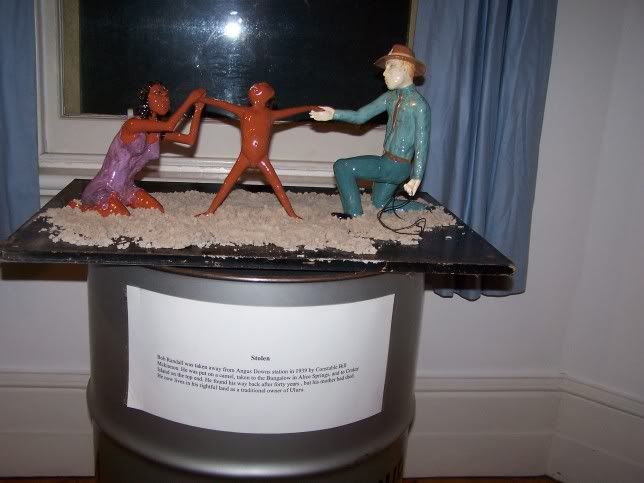
STOLEN

Work of Hazel McKinnon, wife of Bob Randall

The Stolen Generations haunts black Australia.  It haunts some white Australians as well.  When the Howard Government announced The Intervention in 2007, memories of child removal methodology informed the initial response within black communities in the Northern Territory.  These same memories have been articulated in response to the Northern Territory Government's plans to focus on twenty 'hub' communities.  

Nyinkkanyinu is a Town Camp in Tennant Creek.
The signs below are at the entrace to the Town Camp.
Town Camps in one sense are gated communities.
I wonder how they upper end of the socio-economic scale
would welcome signs like these at the entrance of their gated homes.

Governance in remote Australia for black and white communities is problematic.  Remote Australia is out of sight and out of mind of the populous urban fringes - most of whom have no connection to and have never lived in remote Australia.  I have been speaking out for remote Australia, black and white,  since I first took up residence there in 1977.  

I once recall a couple of us in Mount Isa in north-west Queensland speaking to a visiting capital city dignitary on needs in the north-west.  He remarked on how outspoken we were.  I always recall our community health nurse saying "We have to shout to be heard".  For myself, I always felt like it was shouting to be heard over the Great Dividing Range which separated The Outback from the coast.  

But bad as it might be for some whitefella communities, the neglect has been much worse for black communities.  In all my years, the best material I have read on living conditions in remote Australia is by Lieutenant General John Sanderson AC when he delivered the 2007 Annual Oration of the Order of Australia Association. Please download the speech and John Sanderson's bio here.

While ignorance and ineptness and vested interest impacts negatively on the governance of remote Australia, real difficulties should not be overlooked.  We are talking about sparse population in remote areas separated by huge distances.  For myself, I have difficulty in thinking of Victoria as a state.  Because of the distances I am used to in Northern Australia, I think everything within the bounds of Victoria's borders is a suburb of Melbourne.  

A lot of remote Australia is within a harsh arid environment with extremes of heat and, in the lower latitudes, chilly winters.  Water - and its relative, sanitation - is an issue for most remote communities in arid zones.  Recycling can be next to impossible because material needs to be transported to large centres, if not interstate.  

And speaking of transport.  Everything related to transport is an issue - delivery of health and other professional services; prices for everything and the time taken to order and receive anything; roads - and if there are any, bitumen or gravel, maintenance.  In fact, some Outback communities have had to give up bitumen roads - believe it or not - because they can't afford the maintenance.  They have found that it makes more sense to have an affordable, maintainable gravel road than a pot-holed bitumen road which they can't afford to maintain regularly. 

And housing - the only housing developer in these areas is a government housing authority, if it still exists and provides social housing.  And education - the post is already long enough and that topic is too complex for a limited space.  But by now, I hope you are getting the picture.

That is the generality - now translate that down a few rungs to Aboriginal communities afflicted by poverty, substance abuse, poor health, lack of sporting and leisure facilities, and lack of opportunity.

So we are left with limited and limiting government budgets and city based bureaucrats and politicians (most are not from the remote areas) to manage equitable policies.  Are we licked before we start?  This is the political reality - irrespective of which party is in government.

Now to the current issue - the Northern Territory government is to focus on twenty community hubs.  Controversial though this may be, I support the concept in principle and I will read with interest reports due out to-day which will give more information about what the NT government has in mind.  Economic development is badly needed to undergird any progress in Aboriginal disadvantage - and I am not trying to sound like Noel Pearson.  Enforced poverty provides little benefit.  Economic progress provides much.

How does a government (hopefully working with the private sector and properly consulting with the communities which it seeks to serve) bring some semblance of equity into this situation?  Firstly, it is impossible to do it in each and every homeland across The Territory for the reasons stated above.  I take on board the comments of Professor Jon Altman but I am also conscious of Bismarck's  famous quote - Politics is the art of the possible.  

Surely, the imperative of economic development demands a focus on the larger communities.

My view, though, is that the people in the homelands must not be ignored.  In short, I support the 'hub' focus while providing strategies to enable ease of contact with those who have homelands interests.  In short, the hub should be seen as either the centre of a network, a spider's web.  Or it should be seen as the hub of a wheel with spokes radiating to an outer rim.  The rim in this analogy would represent the homelands and the spokes would represent easy access from homeland to hub.  

Practically, it might mean that Monday to Friday people might live in the hub to access professional services, health services, schools and so on.  Week-ends would see an exodus to homelands.  White commuter communities operate this way - and so do many Aboriginal people in the Northern Territory who may reside in major centres like Tennant Creek or Katherine and then "go bush" at weekends.  

When I read to-day's reports, I will be reading them with an eye on whether they have the scenarios of whitefellas charging like a bull at a gate or whether there will be an attempt to reach accommodation with diverse Aboriginal nations and communities across The Territory.

Total Pageviews