Showing posts with label FoodBowls. Show all posts

Monday, 25 June 2012

Welshpooll Lock the Gate Meeting to-night : Victoria's Gippsland Foodbowl - assaulted by CSG and Fracking.


Things are hotting up in Gippsland - and it's certainly not the weather. 
For more info on how CSG and Fracking
is invading Victoria's beautiful,  rich, and beloved foodbowl

And if you want to get off your rear end and do something about,
My friend and Networker Junnita is keeping me/us up to date on this.

 There is another Meeting locally in the Welshpool Hall 
at 7.30pm Monday night June 25th. 
There will also be a film shown too.


Enhanced by Zemanta

Thursday, 8 December 2011

The Proposed Basin Plan documents and fact sheets. Enough here to make your eyes glaze over!


An ordinary mortal in coming to grips with the material put forward by the Murray Darling Basin Authority (MDBA) in regard to the Proposed Basin Plan is quite a hurdle. I have been remiss in the timeliness of getting these documents to you on line, Networkers.  So.. I hope you have been over at the website.  I have been battling all manner of ill health this past month and this week has been taken up with all manner of medical and allied medical visitations ... and there is a biggy next week.  I am having yet another mammogram but expect this one to enable me to celebrate ten years free of breast cancer!

~~~~~

There is a mountain of material on the MDBA website.  There are the comments from Minister Tony Burke and the Chairman of the Authority, Craig Knowles.  There's a decision to be made about whether one can get to any of the listed consultations.   The consultations appear to be less numerous and widespread than those held by the Authority when the Guide to the Draft Plan last year.  However, I am advised that the current list is only for consultations prior to Christmas.  In the New Year, a new list will appear with more extensive consultations, including Melbourne, on the list. I was able to attend the consultations in Shepparton and in Melbourne last time....but, while the spirit is very willing, the body has got somewhat weaker in the ensuing year.

I did this week attend The Low Down held at Environment Victoria this week.  Lead speaker was the marvellous Juliet Le Feuvre.  She was ably followed by the more than capable Domenica Settle.


These two women are the Rivers Campaigners/Experts for Environment Victoria.
~~~~~~
However, I will begin at the beginning.  The material below is available from the the Authority website.  I download it here, because for some it is more accessible and may prove easier to locate in the longer term.  

I do commend the authority on the document regarding the individual catchments of the Murray Darling Basin.  The individual maps provided are valuable and, I have to wonder, whether teachers might take a good look at the document for classroom use.  In addition, I wonder if localised tourism could be enhanced by marketing catchment tours so people can learn about their rivers, the environment, agriculture, and irrigation.  I have lived in a number of these catchments and have travelled in a number of others.  But what better way to get to know your country than by getting to know the Murray-Darling Basin - people could be encouraged to gather a clutch of catchments in an interlinked regional tourism push.


Basin Plan implementation pathway process


Proposed Basin Plan


Knowledge behind the Plan


The draft Basin Plan: catchment by catchment


The proposed "environmentally sustainable level of take"
for surface water of the Murray-Darling Basin: method and outcomes


Climate change and the Basin Plan


FACT SHEET:
The proposed 'environmentally sustainable level of take'
for surface water of the Murray-Darling Basin


Flooding and the Basin Plan


Hydrological modelling


Managing Australia's water resources


Sustainable diversion limit compliance


Transitional and interim water resource plans


Water Quality and Salinity Management Plan


Communication products for draft Basin Plan release

Delivering a healthy working Basin

Questions answered

Now if you aren't worn out, asleep, or thoroughly bored witless
I won't download any more docs.
HOWEVER,
please go to these linked documents
Supporting Documents
Environmental Watering Plan - What's in it and how will it work?

If it were 1 June, I would suggest gathering the family around the fire for a reading session and you could each take a doc and read snippets to each other over a succession of nights.  This should only take about three months so that on 31 August you can quiz each other and see who passes the comprehension test.  On the first day of Spring collapse in a heap and then hibernate until Christmas.  

Instead it's December. It's hot. Some catchments have had floods already this season and some are keeping an eye on their rivers for more of the same.  The documents have been out for just under a fortnight and there's just over a fortnight until Christmas.  Oh, well. Forget the Christmas Cards.  Give everyone in the family a store gift card.   Who has time to shop?  Merry Christmas and we'll see if we can get this sorted in the New Year.

Saturday, 26 March 2011

The NSW Elections - Part 2: Tim Duddy, Independent candidate, seat of Upper Hunter

Amplify

Tim Duddy on the stump

Tim Duddy is running as an Independent candidate in the seat of Upper Hunter which includes the great NSW food bowl of the Liverpool Plains.  Tim has played a significant role in the Caroona Coal Action Group and the maintenance for a year or more of the community blockade by the group as they took on major national and international coal corporates threatening the food bowl.  See more on this here and here.  You may have seen him on the Four Corners program about the blockade.  Tim is active in his own community as demonstrated by his position as Councillor on the Gunnedah Council.  

You can read more of Tim and the activities of the Caroona Coal Action Group at Denis Wilson's blog, The Nature of Robertson.  

The seat of Upper Hunter is National Party country through and through.  One would think that Tim would be a true green and gold National Party man. But Tim is standing, standing up to be counted on the issue of food security and the intrusion of the mining corporates into our lives and the lives and business of those who provide our food.  Tim is clearly a community minded man but also a man who can deliver as his active involvement in the maintenance of the blockade proves.  Please consider him strongly when deciding your voting intention.
Click to enlarge
TWEETED APPROXIMATELY 7.05PM


TWEETED APPROXIMATELY 15 MINUTES LATER


COMMISERATIONS , TIM!

Enhanced by Zemanta

Sunday, 17 October 2010

The Riverina floods: entering the mindset of O'Brien’s Hanrahan


Grapegrower Steven Barbon, accompanied by Fido 
on his sodden property near Griffith yesterday, 
believes proposed water cuts will destroy regional Australia. 
Picture: Amos Aikman Source: The Australian

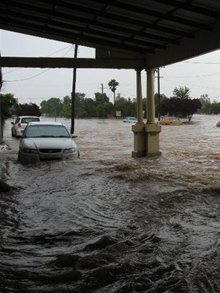
In Australia, the driest inhabited continent on earth, we have gone from The Big Dry of the ten to twelve years of drought to 2010 and The Big Wet.  Floods again in the Riverina.  I believe we have entered the mindscape of John O'Brien's Hanrahan.

Lockhart, NSW - Photo from here
More pictures and 
Flood infromation from the ABC available here.

SAID HANRAHAN

by John O'Brien 

"We'll all be rooned," said Hanrahan,
In accents most forlorn,
Outside the church, ere Mass began,
One frosty Sunday morn.

The congregation stood about,
Coat-collars to the ears,
And talked of stock, and crops, and drought,
As it had done for years.

"It's looking crook," said Daniel Croke;
"Bedad, it's cruke, me lad,
For never since the banks went broke
Has seasons been so bad."

"It's dry, all right," said young O'Neil,
With which astute remark
He squatted down upon his heel
And chewed a piece of bark.

And so around the chorus ran
"It's keepin' dry, no doubt."
"We'll all be rooned," said Hanrahan,
"Before the year is out."

"The crops are done; ye'll have your work
To save one bag of grain;
From here way out to Back-o'-Bourke
They're singin' out for rain.

"They're singin' out for rain," he said,
"And all the tanks are dry."
The congregation scratched its head,
And gazed around the sky.

"There won't be grass, in any case,
Enough to feed an ass;
There's not a blade on Casey's place
As I came down to Mass."

"If rain don't come this month," said Dan,
And cleared his throat to speak-
"We'll all be rooned," said Hanrahan,
"If rain don't come this week."

A heavy silence seemed to steal
On all at this remark;
And each man squatted on his heel,
And chewed a piece of bark.

"We want an inch of rain, we do,"
O'Neil observed at last;
But Croke "maintained" we wanted two
To put the danger past.

"If we don't get three inches, man,
Or four to break this drought,
We'll all be rooned," said Hanrahan,
"Before the year is out."

In God's good time down came the rain;
And all the afternoon
On iron roof and window-pane
It drummed a homely tune.

And through the night it pattered still,
And lightsome, gladsome elves
On dripping spout and window-sill
Kept talking to themselves.

It pelted, pelted all day long,
A-singing at its work,
Till every heart took up the song
Way out to Back-o'-Bourke.

And every creek a banker ran,
And dams filled overtop;
"We'll all be rooned," said Hanrahan,
"If this rain doesn't stop."

And stop it did, in God's good time;
And spring came in to fold
A mantle o'er the hills sublime
Of green and pink and gold.

And days went by on dancing feet,
With harvest-hopes immense,
And laughing eyes beheld the wheat
Nid-nodding o'er the fence.

And, oh, the smiles on every face,
As happy lad and lass
Through grass knee-deep on Casey's place
Went riding down to Mass.

While round the church in clothes genteel
Discoursed the men of mark,
And each man squatted on his heel,
And chewed his piece of bark.

"There'll be bush-fires for sure, me man,
There will, without a doubt;
We'll all be rooned," said Hanrahan,
"Before the year is out."

Around the Boree Log and Other Verses, 1921
This has been republished from the free e-book

Monday, 20 September 2010

We've got the mining cowboys - now the Indians are coming to get our coal?

Australia now appears to be a country in search of a Carbon Price.  With a minority government, the labyrinthine twists and turns in this search will be an ongoing political interest.  Coal - the ultimate carbon polluter - is big in this big country.  Someone seems to be keeping an eye on this and I hope more people join in.

Wikipedia is a democratic information vehicle.  Anyone can join in, make a contribution, edit the contributions of others - and everyone can keep watch.  The entry for "Coal in Australia" is quite extensive and put together in a coherent and accessible manner.  The watch is being kept it would seem.  And it needs to be.

As you will see from the Wikipedia entry, Networkers, coal is huge but there is no mention of Chinese interests.  However, Shenhua has been exploring in the Liverpool Plains area of New South Wales.  The Liverpool Plains is one of Australia's major foodbowls.  People in this area have been involved in a long campaign to preserve their land and their livelihoods.

Australians are hardly on an energy diet as we continue to consume plasma television sets and other high energy users.  However, there is nothing like a highly populous country for energy hunger.  Japan, currently estimated to have a population of 125 million, came into Australian long ago.  Japan is Australia's biggest coal customer but has also been a miner here in joint ventures such as the Thiess Peabody Mitsui venture at Moura in central Queensland.  Through Japan Coal Development Australia, Japanese coal investment in Australia continues.  The coal developments in Central Queensland however, have not taken prime agricultural land as is now set to occur in the Liverpool Plains in NSW and the Darling Downs and South Burnett areas of Queensland.  The land that the Japanese mines disturbed was cattle grazing country.

Now we see China on the move in Australia through Shenhua, the world's largest coal producer.

In addition, it appears that India is gearing up for international coal investment.  It will be a surprise if Australia is not on India's radar as an investment prospect.  The likely Indian investment vehicle is government owned - as in China's Shenhua - Coal India Limited. Coal India claims to be the largest coal producer in the world.

Add to this our own majors, Rio Tinto Coal and BHP Billiton, and a string of minor miners, you can imagine, Networkers, that we have some industrious, ambitious, and determined people out to gobble up our land and, perhaps, make Australia one large continental quarry.

 It has been the export dollars from the resource industries  - as well as the Economic Stimulus Plan - which have enabled Australia to weather the Global Financial Crisis (GFC) better than any other nation on earth.  Our employoment figures are good.  Those are the plus signs.  However, there is a downside.  People living near open pit mines are complaining of health problems and dust-affected lives.  Foodbowls are under threat as well as our environment.

Governments - local, state, federal - are always suckers for development: rate, tax and royalty bases; population growth; jobs and so on.  The preservation of ecosystems, the biospheres of food, air and water, are not do or die issues with our elected representatives.  Resource industry promoters, however, can mean political life or death to governments and individuals involved in politics.  Somewhere, it seems that our daily bread and milk and fresh air needed for survival are not important.  Those things, it seems, will come from somewhere else if need be.  But if not from here, where?  The world population continues to skyrocket as arable land decreases by the minute.

Where lies Australia's food and water security if we don't give it the value it warrants?  Already Australia is a net importer of foodstuffs in which we were once self-sufficient.  If we can't be self-sufficient in food and water for our own population in our own land, we are mendicants.  We are beggars seeking sustenance from Empire - whichever empire is dominant at the time.

Our national government is doing business at the end of a very fragile thread.  Now is the time to capture their attention.  Now is the time for Australians to co-operate in working for what we need most, what we value most.  Our livelihoods, our heritage, our very lives may be at stake.

Do we want to throw the most valuable parts of the human condition away for more plasma tvs, broadband, and a job without Australian food and with heavily regulated, privatised, expensive water?
Further reading:

Sunday, 19 September 2010

Egg on Ambre Energy's corporate face? Yes, if Friends of Felton have anything to do with it.


OK, Networkers, you've had breakfast?  For many of you, I'll bet it included an egg.  Imagine your Sunday breakfast without an egg or perhaps a very expensive egg because there are not enough to go around.  Or perhaps - even worse - imported eggs from heaven knows where!

This week the Friends of Felton have been busy making these sorts of points as they too to demonstrating with a barbecue outside a Toowoomba hotel where Ambre Energy was touting its wonderful credentials in the coals to liquidsbusiness.  Below is the view from the farms of Felton.
~~~~

Wednesday, 1 September 2010

A view from the coal seam gas front: Water and Food versus Gas and Energy


A report from out Walgett, NSW, way re coal seam gas (csg) extraction:

I am constantly flat out with the GAB and csg issues at the moment -  it is suddenly exploding.   Not only have Santos started seismic testing in our area (suddenly and silently) - but also we (GABPG) are liaising with the BSA (Basin Sustainability Alliance) up on the Darling Downs, who are fighting the csg industry there - and are in desperate straits.  

NSWFA meeting was absolutely brilliant -  huge crowd (and a lot of politicians there), and the speakers were fantastic.  Such absolute professionals and experts in their fields, it was most informative and incredibly well done.   


Fiona Simson (who is head of the NSW Farmers' Mining Taskforce, and is now their Vice President) has just returned from a trip to Powder Valley USA - to check out the situation there, and she spoke eloquently and showed photos of the complete devastation caused there by csg.   It began there (Powder Valley) in the early 1990's - and is the longest that anyone has had csg.    She said within the first month, the artesian flows disappeared.  Within the first year, stock and domestic flows disappeared.  She said the bore levels dropped 100m every 10 years.

The ruination of the aquifers (and soil and land) there is just frightening - and her photographs and talk were terrifying.   She showed photos of a town that has been totally evacuated and abandoned, due to csg mining.   The methane was coming out of their taps, and literally bubbling in the streets - so the whole town was evacuated and is now a ghost town.  Fiona is an incredible speaker, no notes, not one um or ah, she just spoke clearly and powerfully.   I think she's going to put the info. up on the NSW Farmers' site, if you wanted to look at it -  but she had only just returned from the USA so hadn't had a chance yet.

Other brilliant speakers were the Dalby solicitor Peter Shannon (presenting the legal viewpoint of access agreements and lack of landowners' rights), and the wonderful John Polglase -  I think he is a forensic scientist and hydrogeologist among other things, but I will have to check!   I could have listened to him all day.

It was the most enormously informative day, and it provided so much solid information - and the experts gave us a lot of question time.   It was so good of the members of the Basin Sustainability Alliance to come down from Dalby to give all their assistance and information.  
I honestly think we've suddenly had a breakthrough, don't you?   So many real experts in that field, all united against it - I feel (I hope!) the tide has turned!


Regards,
Further reading:


  • Fiona Simson, NSWFA Mining Taskforce Chair


Chinese investment in Australia: will future interests conflict?


It ill behoves me to draw attention to statements by a former economic adviser to George W. Bush.  But here you are, Networkers.

I am not one to get nervous or up-tight about foreign investment in Australia.  We whitefellas took over lock, stock, and economic barrel and didn't go away - so howzat for foreign investment!  

However, we Anglo-Celts and those who don't mind living with us dominate.  Some of us would like to keep our autonomy and self-determination (yeah, I know, we are not good at allowing the same processes to the First Nations but I'm fighting for that, too).  

Trouble is that I don't have a lot of confidence in Australian assertiveness in foreign relations.  We like to big note ourselves as tilters at authority - but we are not, you know. 

Someone once wrote - it might have been Sol Encel who did a lot of good stuff on Australians and authority - that in Australia anyone in a blue hat can direct the traffic.  Ever noticed that?  If there is need and someone just gets out and starts directing people, we follow.  

As a nation, we are great forelock tuggers.  First of all, we tugged it to England and Empire. And many still do.  For the past sixty years or so we have been tugging it to the USA and have become part of its Empire. I think if a referendum was held to-morrow for Australia to become the 51st state of the USA instead of just a colony, the proposal would get up.  

But now China is the emerging imperial power - and it is buying into Australia, just as England and the USA have done in the past.  But times they are a'changing.  China has a lot of mouths to feed.  China is not a democracy.  With England and the USA, we had distinct ethnic and language ties.  Except for the increasing number of Chinese Australians who are still a minority and a long intertwining of history , we don't have the same common heritage.

My concern is how assertive Australian governments and corporations are prepared to be on behalf of their own people, their own nation. 

For instance, in the matter of Food Security:  

Food Security, because of population growth and global warming, is set to become an issue even in a prosperous country like Australia.  There is considerable Chinese investment in agricultural holdings in Australia.  If we have need in this country and China has need in its country, will China still be allowed to export its Australian-grown and manufactured food to its homeland from Australia?  This is what bothers me.  

Are we able to withstand the blandishment of the renminbi.  For example, take the ritual courting movements of Rio Tinto and China in the last year or two - and it managed to continue while Rio's executives were languishing in prison on corruption charges!

On the Liverpool Plains in NSW, where landowners in one of Australia's richest foodbowls have been doing battle against miners, the intruders have not only been our own BHP Billiton but Shenhua.  These resource buccaneers claim they are only exploring - but this is not true.  These titans are very sure they will hit pay-dirt and then more of our beautiful food-producing landscape will succumb to the unsightliness and horribleness of the open-cut pit mine.

In this post-election period, there has been much discussion on the topic of transparency.  I would like to see transparency in the matter of our foreign relations - both from our government but also from business. I want to see government and business taking their roles as Australians seriously.  I want to know that Australian governments and corporations are not on sale to the highest bidder.  I want to know that Australians come first with them - even above the almighty dollar and yuan.  I want to know that the needs of this nation and its people will be given the highest priority by its government and its corporations.

In short, I don't want to see kow-towing and obsequity.

Further reading:

The Biggest Dry......and The Biggest Wait

Circle of Blue has produced a whole section of Australia's Biggest Dry.  You will find it here.  It covers so much, complete with videos. I commend it to Networkers.  It is particularly compelling because sometime soon, when our government is settled, the Murray Darling Basin Plan will be released.  

I am amazed at how few Australians appear to be interested in the MDB Plan.  IMHO, the MDB Plan is the basis for the greatest structural adjustment in this nation's history since white settlement.  Few people know what is in it; what it says; what it recommends.  Already, towns in the MDB are emptying as farmers and irrigators consider or have considered their options for the future.  

The Big Wait for the plan is second only to the The Biggest Dry in terms of expectancy.

I can remember back in the '70s and '80s being moved to tears watching the stories on the 7.30 Report coming out of the dairying reconstruction.  The MDB Plan could be the basis for a much larger agricultural reconstruction than that ever was.  And, tied up with all of that, there is the issue of Food Security which, again, too few Australians seem to have an interest in.

Wake up, Australia.  You are used to thinking of Australia as being self-sufficient in food and exporting the surplus.  This is no longer true - and has not been for some years now.  We are a net importer of many, many food items.  You don't have to take my word for it either - or Bob Katter's.

Do a little research in your very own supermarket - by reading labels.  I have been a label reader for forty years - yet I rarely come across other people doing this in any supermarket I go to.  Now, Australian labelling of food and grocery products could be called "The Big Lie" because it does not tell all that you want or need to know and any push for better labelling is met by the powerful stone wall of the Australian Food and Grocery Council.  

This results in the absurdities of Product of Australia and Made in Australia labelling.  In the simplest of terms, the former means that everything comes from Australia.  The latter means that there are some imported products included in the manufacture of the item - but the label does not tell us whether this is a little or a lot.  And, of course, there is nothing to tell you whether the company manufacturing the product is a wholly owned Australian company; a company with a majority Australian shareholding; or a wholly owned overseas/multinational company.  So, if you like me, want to support Australian companies and Australian jobs, you have quite a battle ahead of you to ensure that you do.....otherwise, you are exporting our jobs to Europe, Asia and the USA.

And all this starts with our water, our land, our care for country - if we bother to care at all.  So, if we say we care, let's get serious - and let's get informed and vote carefully with our dollars at the supermarket - and at the butcher, the baker and the candlestickmaker.

Wednesday, 9 June 2010

Coal Creek Farmers Market: coming soon

A Coal Creek garden 

One thing you have to say about Coal Creek down in beautiful Southern Gippsland is that they are always planning something - big fun-filled community somethings.  The Network's spies down at GippyAgChat are telling that a farmers market is soon to come.  The Network loves farmers' markets whether the produce comes from commercial locals or the grow your own tribe - we like it fresh, localised, with small carbon footprints.  And when it comes from the rolling green hills of beautiful Gippy South we're on.

Applications are now open for prospective stallholders 
at a new authentic Farmers’ Market at Coal Creek in October. 
The Farmers’ Market will be held in the main car 
park on the second Saturday of each month
 from 8am-1pm, starting on Saturday October 9, 
and will bring together accredited farmers and specialist food makers.
More? 
5655 1811 or farmersmarket@coalcreekvillage.com.au/ 


Related reading:
Animal, Vegetable, Miracle: A Year of Food Life (P.S.)
Markets of New York City: A Guide to the Best Artisan, Farmer, Food, and Flea Markets

Related links:

MissEagle racism-free Photobucket

Friday, 16 October 2009

WORLD FOOD DAY: Achieving food security in times of crisis. A report on a trip to Gippsland, Victoria.


THIS POST SERVES TO MARK
to-day
16 October.
is hosting a blogging event
of which this post will form part.


Click to enlarge

On Tuesday 6 October, Belinda, her friend Susan (from Permaculture circles), and I  tripped down to West Gippsland for a food, farmiing and health conference titled
"Nurture the land, Nourish the people..."

This conference was absolutely brilliant.
Sue Webster of Agribusiness Gippsland
with her band of helpers
and the support of Baw Baw Shire
did a marvellous job and showed us
true Gippsland hospitality.
Now below are not my words.
I didn't want to re-invent the wheel.
Sue, in a previous incarnation, was/is a professional journalist.
She precis-ed the conference well in
the latest edition of
Gippy AGchat.

The conference was such an action packed day
I'm not sure if I could report adequately.
Belinda, Susan and I learned heaps.
Networked with lots of interesting people
There were three workshops -
and we were able to divvy these up between us
so we had plenty to chat about on the drive
back to Melbourne.

Conference serves up innovation banquet


Food grown on city wasteland to curb carbon, a Landcare-type movement to save our soils and a Victorian Ministry of Food … those were some of the innovations raised at the ground-breaking Food, Farming and Health conference held in Warragul last week.

About 150 people from interstate and across Victoria came to share visions of nurturing the land while nourishing its people.

The conference, organised by Agribusiness Gippsland, saw speakers from NSW and across Victoria addressing farmers, landholders, water and Landcare representatives, health professionals, teachers, shire and other government delegates.

“It was astonishing how readily these quite-separate groups came together,” said Alex Arbuthnot AM, chair of Agribusiness Gippsland. “It proves that the same issues are top-of-mind across all these sectors.”

Across the audience there was a lot of note-taking going on. During the breaks the buzz of networking was notable. Attendees overwhelmingly returned glowing evaluation forms and many sought another conference next year.

Keynote speaker Andrew Campbell demanded an ‘intersection’ of health policy and agricultural practice for the good of the earth, and the people depending on it.


“We’re not talking climate change but climate chaos,” he warned. “We need to decouple economic growth from carbon emissions; we should shift from fossil fuels to renewable energy. We have to increase our water and energy productivity.

“For example, growing corn to produce ethanol makes no sense at all, it requires more energy input than it produces.” (Longer report below)

The State Nutritionist Veronica Graham shared unpublished data showing that the price of healthy food, such as vegetables, fruit and grains had risen about 20% since the introduction of GST, higher than the rise of ‘non-core’ food. “So if you’re trying to eat healthy food that is an issue especially if you’re on a limited income,” she said.

She also expressed concerns about the loss of farmland to housing. “Urban development is displacing food production, for example at Werribee. This is about policy or land planning and I don’t know the degree of control, but it is concerning.”
DPI deputy secretary Bruce Kefford detailed some of the opportunities ahead for agriculture including GPS for more precise tilling, GM for less fertiliser and chemical applications and modifications to feed to curb greenhouse gas emissions.

“We need to accelerate change,” he said. “Farmers get demonised and I don’t think that’s fair or smart. They’re already part of the solution.” (Longer report below)

Sue Brumby, Director of the National Centre for Farmer Health, warned of the looming “tsunami” of diabetes, especially in rural areas. In Loddon Shire, for example, one person in 10 suffers from the condition.

She praised the conference organisers, led by Gippsland beef farmer Jenny Sullivan.

“It’s just fantastic to see a conference like this,” Ms Brumby said.

Her praise was echoed by Prof Linda Tapsell of the University of Wollongong. She had declined an overseas speaking engagement to attend the Warragul event.


“The situation you now face is for this small region to put it all together and see if you can do something about it,” she told the audience.

The full-day conference included a range of other speakers discussing, among other things:

• Food gardens reclaimed from urban waste ground or roof tops.
• Declining reserves of phosphorus, the world’s major agricultural fertiliser.
• How two people feed 50 families from an acre in Healesville.
• The hazards and heartbreaks of establishing an organic retail business.
• The need to grow pest predators to replace chemicals.

“And much else besides,” Mr Arbuthnot added. “And the day featured a Gippsland- sourced, healthy lunch – proving you eat what you are and you are what you eat!”

The conference was funded by VicHealth, Baw Baw Shire Council, the DPI, DSE and West Gippsland CMA.
~~~~~~~~~~~~~~~~~~

Vision, cohesion and revolt needed: Campbell

Policymakers have left Australia’s rural communities ‘way exposed’ Andrew Campbell told the conference.

The keynote speaker said: “We haven’t created the right frameworks in research, policy and education we’ve left our rural communities way exposed. Our cross-system learning across the boundaries is very, very poor and the general literacy is abysmal across bureaucracy and across corporate boardrooms

“I think we need to revolt direct action at a local level and showing lots of little candles in the darkness, that’s the most powerful thing we can do. You need to use the media and engage some celebrities. In my view there’s a lot of the jigsaws there and these are more likely to be put together coherently at the local level.”


During question time Malcolm Cock, a beef farmer from Hallston asked if it could be possible to decouple food production from economics.

Andrew replied: “I can’t see how we can get economics out of anything, frankly. That’s the system we’re in. But the bigger challenge we’ve got is making the market economics more closely reflect the energy reflected in the price, the more we can get a real price paid by the consumers. I believe food prices need to go up very substantially, although we need to look at that from an equity point of view.”

Considering future development, he said: “It’s a nonsense not to have an integrated approach for transport for water and for power. No one’s going to plant biofuels if they don’t know where the processing plant will be. And no one is going to build a plant if they haven’t security of supply, and then both need transport … we need to integrate all these things. Silos of information exist but agriculture, health and environmental policy should intersect and that’s where we should be putting resources, that’s why this conference is so important.”

He praised the conference for “seeing agriculture as part of the food system and consequently part of the health system and seeing how those things all link together.”

Carbon’s role in the future food supply menu

Anyone planning to supply cost-competitive foods to the future marketplace will have to be a low-emission operation.

Climate change is going to change the economics of food production and delivery, according to an industry expert.


Kirsten Larsen, from the University of Melbourne’s Victorian Eco-Innovation Lab, said In Australia food accounts for 28% of all greenhouse gas emissions. “And that doesn’t include cooking or transporting foods,” she added. That figure compares with 20% from heating and energy outputs and 10% from transport.

She noted that urbanisation is pushing food production further from markets, requiring more freighting. “Emissions from freight are increasing faster than most sectors,” she said. “About 12% of total tonnage is for food and food is travelling further than most other things. In addition fertilisers constitute about 15% of the total weight of what’s travelling through the transport system.”

Other challenges facing food production in the future include shortages of land and fertiliser. There were reports, she said that phosphate rock supply might have peaked.

“If we want to feed 9bn people how much grain will be fed for animals and how much for people. What will we use our land for and who gets to eat? Assuming a linear increase in meat consumption is not going to be coherent with response to climate change,” she warned.

The answer to these could lie with what she described as “food-sensitive urban design” or “how do we produce food in cities for people who live in cities?”

She noted rainfall lost to runoff and organic waste lost to landfill as potential reuseable resources.

She offered examples in the US of small vegetable plots in urban wasteland and of

commercial rooftop horticulture in New York.

She also suggested community-supported agriculture, where consumers transact with farmers more directly – even to joint ownership or leasing deals. “Farmers are carrying a lot of the risk and farmers are the price takers. How do people in the city support this? The community-supported agricultural model might help,” she said. “There’s lots of exciting things happening on the ground but how do we pull this together to get a clear message to government?”

Changes to make gains: DPI boss


Bruce Kefford, the DPI’s deputy secretary scored a lot of approvals in the end-of-day evaluation forms with his vision of farming in the future.

He stressed the opportunities available amid challenging change.

Among the highlights he listed were the use of GPS for pinpoint sowing, fertiliser application and weed control, greater irrigation and water use efficiencies and integrated pest management – using bio-enemies such as competing organisms or buffer crops.

Acknowledging opposition, he also praised research into GM. “It offers some tremendous opportunities when safely and legally used to solve some problems,” he said. He offered the example of research investigating inserting rust resistant barley genes into wheat.


“If there’s no rust on wheat we won’t have to use chemicals,” Bruce said. “This is the sort of benefit we can achieve. The way we get some of our best insights is to go to nature and get some ideas into how to solve a problem.”

He also praised work on methane reduction in ruminant animals. “To my complete surprise I found we have worked out, from our early work on feeds, that we can reduce methane and increase yield,” he said. “We’ve dropped the methane production of cows by 20% and increased production and we haven’t even looked at how the rumen of the cow can be modified.”

He added: “The most important thing we can do is provide a range of healthy foods”, specifying grains of lower GI and leaner lambs.

“We need to accelerate change,” he said. “Farmers get demonised and I don’t think that’s fair or right. They’re already part of the solution.”

During question time, he was asked his thoughts of giving agriculture a wider scope – and possibly a bigger labour catchment – by renaming the Department of Primary Industries the Department of Food.

He replied: “We’re a sector that’s more comfortable quietly getting on with the job and that brings with it the cost of being undervalued. This could be working against us.”


MissEagle
racism-free
Photobucket

Saturday, 26 September 2009

DUST WATCH INTERIM REPORT: 22-23 SEPTEMBER

This report has come to The Network
courtesy of that great Networker, Activist & Environmental Researcher
Maria Reidl of Mildura, Victoria.
Thank you Maria.
And thank you to the DustWatch Team in Gunnedah, NSW.
The Network would welcome any similar reports from across the country.
I commend the work of this group because it highlights not only the agricultural and economic impact of this disaster, but the social and health aspects as well.  
In fact, for many Australians, it has impacted every part of their lives this week.
I don't know what to say, except that some of us are thinking of the realities faced by many Australians across the nation
~~~~~~~~~~~~~~~~~~~
DustWatch interim report 22-23September
Prepared by John Leys and the DustWatch Team, Gunnedah

Dust storms have been occurring regularly in western NSW and around Lake Eyre in South Australia for the last two months.

Dust is from drought-affected areas in Western NSW and the eastern Lake Eyre Basin. It is not from the Riverina as reported.

We are losing about 75,000 tonnes of dust per hour off the NSW coast north of Sydney.

This information is sourced from the DustWatch community- based monitoring project. This has and is being funded by NHT, Caring for our Country (C4oC), from grants from Lower Murray Darling, Murray and Lachlan Catchment Management Authorities plus in-kind contributions from all inland CMAs. The project is supported by DECCW in NSW and nationally via Griffith University with funding from LandCare and C4oC.

Two Dust Storms

On Tuesday 22, a dust storm passed though Canberra (picture below) which was about 200km wide and came from the lower Lake Eyre Basin


(source: http://rapidfire.sci.gsfc.nasa.gov/subsets/index.php?subset=Australia5.2009265.terra.1km )
  • The second dust storm started on Wednesday 23 and hit Sydney the same day. It started Tuesday 22 in South Australia (can be seen in the far west of the picture as a rolling dust storm) and arrived in eastern NSW on very strong (80-100km) westerly winds today.
  • There is no satellite image for this dust storm at the time of writing.
  • This storm is huge! We are losing about 75,000 tonnes of dust an hour off the NSW coast north of Sydney.
  • Worst event since the 1960s.
  • The event extends from the Queensland border down to the Riverina. It missed Hay and the south west corner of the State.
  • The dust results from low ground cover exacerbated by the extended drought and very high winds (80-90km/h).
Description of Dust Storm
The DustWatch community network has recorded the following events:
  • Broken Hill: first storm Monday 3 hours duration – severe dust storm. Second storm Tuesday 6 hours duration - severe dust storm,
  • Bourke: 6 hours duration – severe dust storm, started Tuesday night now finished
  • Cobar: 12 hours duration, still going at 8am– severe dust storm
  • Condobolin: 3 hours duration – severe dust storm, still going and dusty
  • Coomba: 3 hours dust on Monday –moderate dust storm
  • Cowra: 4 hours duration – severe dust storm, clearing now
  • Dubbo: 6 hours duration – severe dust storm, and still going
  • Gunnedah: 5 hours duration, still going on – severe dust storm and still going
  • Hay: no dust storms
  • Hillston: no data
  • Ivanhoe: 2 hours duration – severe dust storm
  • Lake Victoria: no dust storm
  • Parkes: 4 hours duration – severe dust storm, clearing but still very dusty
  • Menindee: 4 hours duration – severe dust storm and now clear
  • Moree: 3 hours duration – severe, still going
  • Temora: 1 hour duration - mandate dust storm, still hazy
  • Tibooburra: 30 hours of dust –since Monday night! – two severe dust storms, finished midnight
  • Walgett: 6 hours duration – severe and still going
  • West Wyalong: 4 hours duration – moderate and clear now
  • White Cliffs: 7 hours duration – severe dust storm and the dustiest place in the state!
Implications
  • Soil loss from farming land
  • Disruption to transport: airlines, motor cars, ferries
  • Dust pollution, e.g. filters in air conditioners
  • Health implications from fine particles
  • Cancellation of sporting events – imagine if this happened on Saturday!
  • Deposition to oceans of iron rich dust, like this dust, will cause phytoplankton blooms in oceans
  • Dust on snow decreases aledo and makes glaciers melt faster
  • Red, fine dust tends to warm the upper atmosphere so has impact on climate
Solutions
  • Keep ground cover above 50% by using good land management practices
  • Wind breaks and trees in the landscape
John Leys, Stephan Heidenreich and Mike Case
The DustWatch Team

Dr John Leys
DustWatch Southern Co-ordinator
Principal Research Scientist, 

Scientific Services Division, 
Department of Environment and Climate Change
PO Box 462, Gunnedah NSW 2380, AUSTRALIA
Ph +61 2 6740 2345 Fx +61 2 6742 3129
E-mail john.leys@environment.nsw.gov.au

DustWatch is funded by the Lower Murray Darling, Lachlan, and Murray CMAs, the Department of Environment, Climate Change and Water NSW and Griffith University.

Acknowledgements:
The MODIS image is courtesy of MODIS Rapid Response Project at NASA/GSFC, the fire data is courtesy of the Fire Information for Resource Management System (FIRMS) and the rainfall map of the Australian Bureau of Meteorology. This project would not be possible without the assistance of all the DustWatchers who provide observations and help with maintenance of the instruments at the DustWatch stations. We gratefully acknowledge their contribution.

Further reading:
East Coast Lows and Dust Storms

The Melbourne dust-storm of February 1983


MissEagle
racism-free
Photobucket

Total Pageviews