Showing posts with label The Outback. Show all posts

Monday, 13 April 2015

The historic role of Muslims in the development of Australia. Something for those who pursue hate against Islam to think upon.

Cross-posted with Beside The Creek

The ABC program, Compass, last night and to-day, broadcast a wonderful program about the role of Afghan cameleers in opening up The Outback of Australia in the 19th century.

The program, By Compass and Quran, will be available on ABC iview until 7.30pm on 26 April 2015.


It is a wonderful insight into another world.  The cameleers married Australian women - white women, Aboriginal women.  Their descendants speak strongly and fondly of their Afghan forebears. There is also film of original mosques in which the cameleers prayed. And there is also a comment on why camels are now a plague in outback Australia.

This Q&A is now closed. Thank you for all your questions. 
Thank you very much Kuranda.-------Please give a warm...
Posted by Compass on Sunday, 12 April 2015

The Outback so often in reality becomes The Outback Outofmind. Forgotten - economically, socially, politically.

Time and time again, remote Australia is ignored and forgotten --- and yet so much of our wealth has come from there. Even those corporates who grow fat on The Outback tend to ignore it too.  I have spent a fair slice of my life in remote Australia on the Barkly Tableland - on both Queensland side and Territory side.  Its spirit is embedded in me, a part of me, a part of my persona.  

Thank you, Paul Quinlan for this poem.  
Hope you are keeping well and busy.  

The photo below is by Keith Vipond
and is published on Tennant Creek Friends.
Tennant does have some wonderful sunsets
and this site is one of the best places to view them.


Paul Quinlan
Paul Quinlan11 April 20:53
LET'S GET IT RIGHT.

It's not the town that makes the people,
but the people that make the town,
I've seen them come, and also go,
and the weak ones left with a frown.

Some have lived here more than 50 years
they have seen happy times , and also the tears
not like those that pack up, and leave
they work for the town in which they believe.

Some came with only the shirt upon their back
looking for a fortune somewhere up the track
they stopped at this oasis , known as Tennant Creek'
met some of the locals, and stayed a bloody week.

They found some work, and said "I think I'll stay".
then in no time had their own business on the way
Electricians, plumbers, fencers, welders, and the like
along with their women, didn't cheat or pike.

A fair days work for what it was worth
these ones were the salt of this earth
some of them you'll never know
they sadly passed on some time ago.

There's still many friendly people living here
that hold this little town so dear
so if you find yourself down, and out one day
befriend a local , and you may even stay.

Quino 2006

Sunday, 26 August 2012

Being Bush and Black counted in yesterday's Northern Territory election


Networkers, I am sure you will have tuned in last night or this morning to hear the results of yesterday's Northern Territory election.

Before I go on, let me give some full disclosure.  From 1993 to 1997, I was the electorate officer for Maggie Hickey, the then Member for Barkly (ALP) who later became Leader of the Opposition in the NT. The seat of Barkly has two major towns - Tennant Creek and Borroloola.  When I went to work for Maggie, she held the seat by 93 votes having won it from a former CLP Chief Minister. In 1997, our teamwork meant that we made Barkly a very safe Labor seat.  After fifteen years, it still is and Gerry McCarthy, the current MLA, held on to his seat last night.

While it galls me to have to say that I am thrilled with the election result and the CLP victory, the fact is that I am - for all the reasons that Chris Graham outlines.

After all my years in politics, I don't believe that longstanding safe seats - or taken for granted constituencies - are good things.  My favourite political slogan is "Make it marginal".  In short, keep politicians on their toes and working for you.  It is a shame that it has taken two horrendous pieces of public policy affecting adversely the lives of Aboriginal people to shake Labor to its core in the NT.  

While some people whom I don't like may get a seat in the new NT Parliament  - Bess Price may win the seat of Stuart and she favours The Intervention, and then there is Alison Anderson who I wouldn't trust from A to B - I am proud of what Aboriginal people have done in this election.

The seat of Barkly was always ignored - the Berrimah line and, in my view, a Mount Nancy line by which Tennant Creek was ignored by Alice Springs as well as Darwin. The northern suburbs of Darwin, until now, had always been the significant political vote changer. Probably for the first time in Australian political history, we have seen the vote of people in remote areas change a government.  The remote area voice has triumphed over the urban voice.  And not only was that an Outback vote, it was a Black vote.  How significant is that!

I found Clare Martin's comments in the wash up last night astounding ... and if that is a true reflection of ALP thinking, then the party has a long way to go in coming to an accurate analysis of what went wrong for them.  Martin said that there has been more money than ever before put into Aboriginal communities with The Intervention/Stronger Futures program.  Sure, she said, there were some problems in the housing area but there had been a substantial amount of new housing built. 

This goes back to what I call the old "achievement by dollars" syndrome.  I remember when Bob Hawke was met with ridiculing laughter at a World Council of Churches Congress event in Canberra for a similar statement.  The ridicule hit home and after that, attached to information about dollar spending, reports from the Aboriginal portfolio used to speak of outcomes.

Politicians must realise - and I wonder if the major parties will - that it doesn't matter how much money is poured into electorates, whether they are black or white. Unless there is honest consultation with people and people's views are acknowledged and worked with, all that those dollars will deliver is but shifting sand.

The big decider for Aboriginal people was The Shires vote.  Out in white Australia most people will not have a clue about this policy area and its significance on the ground.  Opinion has been divided in Aboriginal communities with regard to The Intervention.  It is my guess that there was no division in relation to The Shires.  What the CLP will do with this knowledge remains to be seen.  It is almost certain that they will abolish the current Local Government system... and then we will have to see what comes next and what the results of any new policy are. 

There is another factor which may be significant.  From what I have seen of the new Chief Minister, Terry Mills, he seems a nice man.  Now this comment may seem a bit twee in the political context but I have to say that the old CLP which lives on in my memory was horrible: it was corrupt, racist, played the racist card election after election, was riddled with cronyism, and had some very nasty and vicious players.  Back in those days, to get anywhere in the NT it was advisable to be a member of the CLP ... and you were assured of preferrment if you were a member of the Silver Circle.  I suspect this may have changed and, if it hasn't, it will now with the significant Aboriginal contingent on CLP benches.  However, one must not ignore the fact that family relationships (what we whitefellas may call nepotism) plays a significant part in Aboriginal ways of doing things.  In fact, these relationships have been discussed in political commentary in relation to Anderson's electorate success.

Lastly, I wonder if this will have any bearing on Federal Labor's ambitions (as well as Fed LibNats ambitions) to establish a radioactive waste site on Muckaty station, north of Tennant Creek and in the seat of Barkly.  The majority of the Traditional Owners are against the proposal.  However, the Northern Land Council has done a deal with Amy Lauder and her family to establish the dump with the NLC and Lauder set to receive millions of dollars in the deal.  Currently, the TOs have a case pending in the High Court.  


Enhanced by Zemanta

Monday, 20 December 2010

Rural roads - but what about Aboriginal communities & The Outback. #aboriginal #indigenous #agchatoz #roads


I love it when well-resourced individuals in main stream society start whingeing (ahem, complaining) about occasional matters in their life that ignored individuals, businesses, and communities in remote Australia put up with regularly.  

'I love it' is meant two ways.  Firstly, there's my cynical self. Second, there's the self that thinks - OK this time it might hit some sort of useful place from which to springboard into an actionable place.

This article about farmers getting stuck on muddy bush roads is a case in point.

Please note a few things about this article:
  1. Where. Look at where the people the article quotes come from.  They come from northern New South Wales. Please note the central part of northern NSW. They do not come from dry, dusty, isolated outback NSW. The first spokesperson is Deputy Mayor of Moree Plains Shire Council. She is also Deputy Chair of the Australian Rural Roads Group.
  2. Who. The other person quoted is significantly involved in his region.  Significant enough to chair a local floodplain management committee. and to give a testimonial for some agricultural machinery. One assumes he is also a member of the Grain Growers Association
  3. How. The Australian Rural Roads Group has got its act together - and clearly some dollars, as well - and has published a report called Going Nowhere. You, dear Networkers, can download it above.
Now the tone of what I have written above sounds cynical.  I have written in this tone to emphasise the point I wish to make.  

I am supportive of the organisation and ideas behind Going Nowhere.  I have lived too long in remote Australia to do otherwise. I also realise every great movement has to start somewhere.   One has to look, however, at the gaps and begin to move into them - which I hope,  with this post, to encourage the Australian Rural Roads Group to do.

So let's look at the gaps.

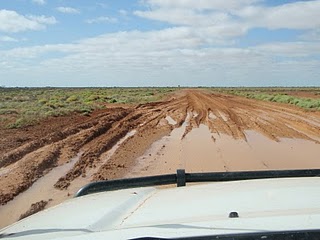
Firstly, I am pleased to see that the cover photograph has been contributed by my blogging buddy, Robbo of Bite The Dust fame.  You can also find him in more up to date fashion on Twitter. As you can see from Robbo's photo and the Wreck of the Week feature on his blog, roads certainly have their moments out where he lives in the Gibson Desert.  You will note the isolation of that bit of Australia marked in red.

Now go to the map in the Going Nowhere report. The most isolated and remote parts of Australia, including Robbo's domicile, are not give the green of participation.  

And to give some information and a big dose of reality, let me take you to my old stomping ground of the Barkly Tableland which is in the Northern Territory and slap bang in the middle of the Australian continent. Ali Curung is a significant Aboriginal community in the Barkly Shire and you can read about it here. Please note the second last sentence.
Ali Curung is fortunate to have a bitumen road to the community. During the wet season the main road to Ali Curung is usually open to traffic, however dirt roads connecting outlying communities are often unusable.
You see, bitumen roads to Aboriginal communities are remarkable.  Sometimes, to travel to an Aboriginal community in the NT, it may be bitumen most of the way such as scooting along the Stuart Highway.  Then the last few kilometres to the community are dirt - as if to reinforce the second-class status of Aboriginal citizens living in communities.

Go a bit further down the highway to the Epenarra turn-off.  This is the situation there.  Note the picture in the top left hand corner.

Now, I don't know what you think Networkers (you might let me know), but it seems to me that to have a lively economy - small, medium or large - an all weather road is needed.  That is what the Australian Rural Roads Group is saying too. 

Noel Pearson is fond of lecturing Australia on the need for Aboriginal people to move away from welfare dependency. Long before the majority of Australians ever knew of Noel Pearson, Aboriginal communities in the Northern Territory - and other places too - were trying to do just that.  They were forming businesses. Some were pastoral, some were agricultural, some were tourism based.  Some succeeded - and some have succeeded marvellously.  Some have not.  For Aboriginal businesses and communities, what a difference an all weather road can make.

Without all weather roads, Aboriginal communities can be cut off - not only from developing a vibrant local economy but from accessing business and personal services such as health, education, local government expertise and so on.

In short, when we hear the agenda of Aboriginal needs in the Northern Territory, roads don't get a guernsey.  


The Intervention was founded on halting child abuse.  The doctors found an infinitesimally small number of possible cases. Think about the energy and funding put  into The Intervention with what might have been the case if the same amount of energy and funding had gone into infrastructure such as roads and citizenship entitlements which other Australians take for granted. 


Then something might have been achieved to benefit Aboriginal people, their communities, and the nation.

Sunday, 20 June 2010

ALICE SPRINGS : 6-9 JULY 2010 : Traditional Custodians speaking out for immediate abolition of The Intervention : Stop all racist laws

Click to enlarge

Hope to have more news soon on this.
Please consider.
While Alice can be frosty in winter,
the sun is almost guaranteed to shine.

The Intervention was bad policy when Howard brought it in.
It has continued as bad policy under Kevin Rudd.
Fiddling with the Racial Discrimination Act
won't fix the bad policy or the problem.


MissEagle racism-free Photobucket

Monday, 14 June 2010

The Great Artesian Basin and Jeff Austin get a gong

The Great Artesian Basin. The envelopes marked in red represent regional clusters of springs called ‘super-groups’. The dark yellow represents the major areas of outcropping sediment where the basin is recharged by rainfall, and the arrows broadly represent the direction of groundwater flow.

Australia is a big country and it does the out of sight/out of mind trick very well.  The Outback can be a forgotten place, another country in the affairs of State and Commonwealth Governments.  In watching over Australia's precious water (Australia is the driest inhabited continent on earth), most of the visibility goes to the Murray-Darling Basin.  Sure, the MDB involves four states but the GAB involves three.

It is therefore pleasing that, in this year's Queen's Birthday Honours List, has received a gong from Her Maj.


Medal of the Order of Australia


Mr Jeffrey John AUSTIN RFD, 
Walgett NSW 2832
For service to water management and conservation, and to the community.


Chairman, Great Artesian Basin Coordinating Committee, since 2004.
Member and Deputy Chair, Great Artesian Basin Consultative Committee, 1997-2002.
Chairman, NSW Great Artesian Basin Advisory Committee, 1999-2004; Member, since 1997.
Current Deputy Chairman, Namoi Catchment Management Authority; Member, Risk and Audit Committee.
Former Chairman, Groundwater, Regulated and Unregulated Water Committees in the Namoi Valley.
Former Member, North-West Catchment Management Committee.
An Institute of Public Works Engineering Australia representative on the Local Government and Shires Associations Water Resources Committee, for a number of years.
Secretary, Walgett Aero Club, for the past 5 years.
Controller, NSW State Emergency Services and concurrent local government Emergency Management Officer, 1982-1999.
Director, Walgett Special One (Grain) Co-operative, for 8 years.
Chief Engineer, Walgett Shire Council, for approximately 22 years.
Awards/recognition include:
Reserve Force Decoration, long service award presented to officers in the Reserve elements of the Australian Defence Force.

Congratulations, Jeff and all the team 
working to support and care for
The Great Artesian Basin.
I hope you celebrate with a drop of 
Vintage Bore Water.

Related Reading and Viewing:
http://www.environment.gov.au/water/publications/agriculture/video-great-artesian-basin.html
The Great Australian Artesian Basin and the Source of Its Water
Regions of Australia: Great Artesian Basin, Lake Eyre Basin, Murray-Darling Basin, List of Regions of Australia, Eastern States of Australia
Ranking spring wetlands in the Great Artesian Basin of Australia using endemicity and isolation of plant species [An article from: Biological Conservation]
Geology of Australia: Great Artesian Basin, Geology of Tasmania, Geology of the Australian Capital Territory, Seaham, New South Wales, Gondwana
The hydrology of portion of the Great Artesian Basin near the Peake and Denison Ranges (Geological Survey of South Australia. Report of investigation)
The great Australian artesian basin and the source of its water.
Groundwater: Aquifer, Water pollution, Saltwater intrusion, Groundwater recharge, Water table, Hydrogeology, Artesian aquifer, Watertable control, Surface water, Great Artesian Basin
Gas and oil prospects of the Great Artesian Basin: Paleozoic and Mesozoic possibilities are good over vast areas of east-central Australia

MissEagle racism-free Photobucket

Monday, 2 November 2009

Miss Eagle is winging her way to the Northern Territory


The McDonnells: a stunning backdrop to The Alice

Miss Eagle is spreading her wings to-morrow and is off to the Northern Territory for three weeks.  Will be having a couple of days in Alice Springs and then off to my old stomping ground of Tennant Creek which is situated on the western fringe of my spirit country, the Barkly Tableland.  There is a vital element missing from the map:  the Tropic of Capricorn which is about one hour driving time north of Alice Springs.  Tennant Creek is 504 kilometres (5 hours driving time north of Alice).  However, while both are Arid Zone towns they are vastly different.  I recall once leaving Alice at a particularly dry time when one could not see one natural blade of green grass.  One got to Tennant and, by comparison, it was a tropical oasis.


Sunset from the Gold Stamp Battery, Tennant Creek

I have included a map, dear Networker, so that you can get an idea of of distance.  From Tennant Creek to Darwin is approximaely 1000 kilometres; depending on how heavy your foot is travel time is anything from 7 to 10 hours.  There used to be no speed limits in the NT outside the towns.  However, a few years ago  highway speeds were given 130kph limits.  Now, how well these are enforced is open to conjecture.  The long straight Stuart Highway from Mataranka south to the NT/SA border is ideal for cruise control!  Population is sparse in the NT and a significant proportion is Aboriginal - meaning there is regular contact with the most ancient culture on the whole planet: languages, nations, attitudes, and - sadly - socio-economic differences of major proportions.

Currently, there are many undercurrents in the NT due to the abhorrent Intervention.  I will be keeping my eyes open and trying to be sensitive to views, black and white, around me.  But please remember I am kicking off my sojourn in the place where Samson and Delilah was filmed - and that was realistic.
MissEagle
racism-free
Photobucket

Tuesday, 27 October 2009

The Northern Territory - a failed state or merely a challenged state?


For some people, all they ever get to know about the Northern Territory is the advertising campaigns to attract tourists and stories of Aboriginal disadvantage.  Some people set off up the track in caravans but don't enter into Territory life and so gain little understanding of Territory ways.  For many, including quite a slice of Territory inhabitants, it will come as a bit of a shock to hear the Territory described as a Failed State.  If you don't think that rings true, you might like to go along with Gerry Woods and his description of a challenged state

For me, I'll stick with the first because I agree with virtually everything that Nicolas Rothwell says in his article.  Many times I will read an article on a subject or a place I know well but the article leaves me feeling that I am residing on a planet of one because my own knowledge is so different from what I read.  Not with Rothwell's article.  He and I inhabit the same reality as far as a description of government and governance in the Northern Territory is concerned. And in case you think this does not concern you, think again.  If  you are a tax-paying Australian, you are propping up relaxed whitefella lifestyles and Aboriginal disadvantage and dislocation in the Northern Territory.  You too can have your tax dollars wasted in the failed Aboriginal housing program known as SIHIP.

Rothwell lays it all on the line from the cossetted and comforted middle and upper classes of Darwin's Northern Suburbs without whom, so the political wisdom goes, government in the NT cannot be won to disadvantaged Aboriginal communities who don't see all the money allocated to their needs by the Federal Government because of siphoning by the NT Government and the bureaucratic padding that is day to day employment in the NT, particularly in mainstream centres outside Darwin.

Miss Eagle's view - after most of a lifetime lived in North Queensland and the Northern Territory and a significant proportion of that lived on the Barkly Tableland, Queensland side and Territory side - is that this has to be seen in the context of historic deprivation by governments of all political persuasions at all levels of remote area communities black and white, with black communities being the worst affected.

Rothwell doesn't say this - but he is not far from saying it.

Let me be quite blunt.  Remote Australia pays a huge price

  • economically, 
  • environmentally, 
  • socially, 
  • infrastructurally, 
  • educationally and in 
  • housing and
  • poor health 
for the governments dominated by the white tribes of the urbanised coastal fringes of Australia.

I emphasise that when I speak of remote Australia I am speaking both of  mainstream and Aboriginal Australians while recognising that the hardest hit are Aboriginal Australians.

I look forward to Rothwell's second instalment when he will outline a new way or ways of governance in the NT.  
MissEagle
racism-free
Photobucket

Wednesday, 14 October 2009

Speaking tour - Melbourne - Ampilatwatja walk-off against NT Intervention


STOP THE INTERVENTION


Click to enlarge

Some of the activities for
Richard Downs and Harry Nelson
Richard Downs is the spokesperson for the Alyawarr people,
who have walked off their community at Ampilatwatja
against the NT Intervention and
established a protest camp
outside the boundaries of the Prescribed Area.

Harry Nelson is a senior Warlpiri elder.
His community of Yuendumu has also been at the forefront
of resistance to the Intervention,
holding off the Income Management system
for many months in 2008 and now refusing to sign long-term
leases demanded by the government.

Robbie Thorpe is a local indigenous activist.

MELBOURNE SPEAKING TOUR
Wednesday, 14 October 2009, 1pm
Joe Nap B, second floor of Union House
University of Melbourne
Thursday, 15 October 2009, 1pm
Monash University Clayton
Campus Cinema, Building 10

Friday, 16 October 2009, 10am
Protest March Against Racism
MAYSAR Youth Sport and Recreation Centre
184-186 Gertrude street, Fitzroy
Friday, 16 October 2009, 6pm.
Public meeting
MAYSAR Youth Sport and Recreation Centre
184-186 Gertrude street, Fitzroy
Resistance to Invasion:
the Aboriginal walk-off and protest against the
Northern Territory Intervention.
Speakers include:
Richard Downs, Harry Nelson
 and leading Melbourne Aboriginal activist
Robbie Thorpe.
More info. please contact:
Marisol 0413597315
MissEagle
racism-free
Photobucket
Posted by Picasa

Total Pageviews