Showing posts with label Alcohol. Show all posts

Sunday, 29 September 2013

...in 20 years the proportion of Aboriginal people custody has grown from one in seven to one in four. Silence can be brutal.

The ethics of paternalism in Aboriginal policy

3 Comments
Callum Denness |  24 September 2013
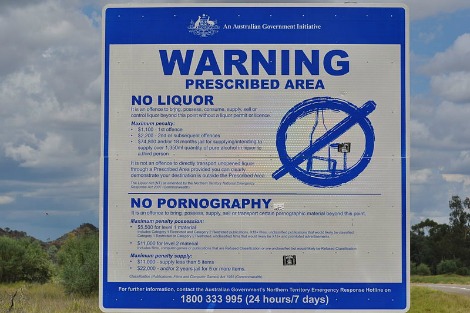
Australian Government sign warns 'No liquor. No pornography.'Following the abuse received by Adam Goodes from a teenage spectator in the AFL's Indigenous round, and the subsequent remarks made by Eddie McGuire, the country became embroiled in a debate about racism in modern Australia. The debate was about words — 'ape' was the pejorative used by the Collingwood spectator — and in our rush to condemn, defend or make sense of the ensuing debate yet more words were spilled across newspaper columns, blog posts, broadcast media and social media.
Meanwhile, the Northern Territory introduced its Mandatory Alcohol Treatment Bill which, if passed, will see more Aboriginal people incarcerated. We were too busy describing the modern face of racism to notice.
The importance of words cannot be diminished but newspapers and bulletins can hold only so many. While plenty were dedicated to the story of McGuire, the teenage girl and Goodes, none mentioned that in 20 years the proportion of Aboriginal people held in custody has grown from one in seven to one in four. The introduction of laws which would criminalise alcohol consumption and introduce more Aboriginal people to jail made the news but did not incite the passions of the commentariat or public, being devoid of sport stars and television personalities.

Saturday, 2 March 2013

Port Hedland, The Pilbara, Cyclone Rusty, Sandy Five: cooking, chomping & drinking your way through the weather!


As Cyclone Rusty bore down on Port Hedland and The Pilbara this week, reports came that residents were stocking up on alcohol as well as food.  A bit of a no-no really because if the worst befalls, it could be best to be sober and, besides, alcohol cannot be taken into the cyclone shelters.

I wonder if over there in The West they gave any thought to what they consumed in that boring time waiting for the cyclone to come and to go.

Networkers will recall that the eastern seaboard of the USA experienced Sandy in late October 2012.  A post-storm phenomenon occurred dubbed by the media as "Sandy Five".  Sandy Five is a reference to the poundage put on by New Yorkers as they chomped their way through the cyclone.

Not only did they chomp, they cooked, and they drank.  Read about that experience here.

...on the day of the storm, I obsessively followed food blogs, Twitter and Facebook where my food loving friends reported how they poured themselves into preparing elaborate meals, from boeuf wellington to home made pasta to Brasilianquindin. Even more interesting was to hear about the indulgence in alcoholic drinks, ranging from the obscure mid-nineteenth century cocktails to cheap wine, a phenomenon that was evidenced in the empty shelves at wine and liquor stores across post-Sandy Brooklyn. As the storm descended upon the city, our kitchen counter too became a non-stop food assembly line, churning out new dishes every hour or so. When the winds calmed down and left behind a devastated landscape, interrupted lives and severed power lines, many shared stories of rushing to the fast food chains to eat “fast” and “bad” foods in search of comfort.

In spite of photographs of empty shelves in Port Hedland, somehow this cookfest does not seem to me to relate as well to The Pilbara as to New York.  However, foodie Pilbarans might let me know if I am wrong and they might like to recount their culinary and alcoholic achievements for The Network.  

And, by the way, Pilbarans, what was your Cyclone Rusty weight gain or loss?

Tuesday, 8 January 2013

Walmart, Woolworths, Pokies, Grog and the Salvation Army - does Roger Corbett have a case to answer

Why is it that one never sees nor hears of an Australian journalist interviewing Roger Corbett about his involvement as a Director on the board of Walmart?  Walmart's poor employee and workplace practices are legion and legendary.  Yet here in Australia we cannot seem to ask questions about this.

Just like how we don't know how the Salvation Army involves itself with Corbett in its Red Shield Appeal while he sits on the Board of ALH Group (the Woolworths grog and pokies conglomerate).  ALH Group is the largest poker machine operator in Australia and on its way to being the world leader in poker machine operations.  So how does the Salvation Army find a synergy of goals with someone like Roger Corbett?  

Friday, 17 February 2012

Vigil and Vale for Terry Briscoe - another death in the wrong place and at the wrong time


This post is written in the spirit of vigil, a spirit of watchfulness and awareness.

Paddy Gibson has asked me to give attention to the death in custody of Terry Briscoe which occurred in Alice Springs.  Paddy is a researcher for Jumbunna Indigenous House of Learning and Co-Editor of “Solidarity” magazine.  Paddy has covered the circumstances of Terry's departure from us here.  There is sadness in the life and the death of Terry.  There is hope expressed in the life of his cousin, Richard Morton. 

Let us all keep vigil so that these avoidable deaths can disappear from our penal institutions and law enforcement practices.  Let us all keep vigil so that there will always be - for people like Terry - another go at life, love, family and community.  Let us keep vigil so that human life and our own humanity testifies and triumphs.


Enhanced by Zemanta

Monday, 12 April 2010

Aboriginal people demanding human rights - once again

Click to enlarge flyer


CALL TO ACTION  CALL TO ACTION  CALL TO ACTION  
CALL TO ACTION  CALL TO ACTION

ALL HUMAN RIGHTS DEFENDERS    ALL HUMAN RIGHTS DEFENDERS    ALL HUMAN RIGHTS DEFENDERS

COULD YOU DISTRIBUTE THE FLYER TO YOUR NETWORKS
ORGANIZE FOR PEOPLE TO COME AND UPHOLD OUR RIGHTS

BRING PLACARDS / FLAGS ON 20/4  – examples
“No Racist Local Law 8”
“Stop Genocide”
“Govt has no Right to Stop our Rights”
“Services & Programs no LL8”
       
ALL COME 
CALL TO ACTION 
WED 14 APRIL
@ 1:30 pm
 @ MAYSAR  
184 Gertrude Street, Fitzroy

MissEagle
racism-free
Photobucket

Wednesday, 20 May 2009

Of Aboriginal hubs and rims

Photobucket - Video and Image Hosting

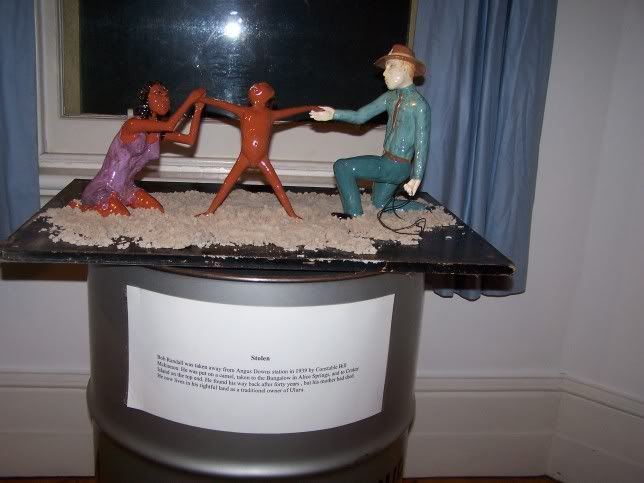
STOLEN

Work of Hazel McKinnon, wife of Bob Randall

The Stolen Generations haunts black Australia.  It haunts some white Australians as well.  When the Howard Government announced The Intervention in 2007, memories of child removal methodology informed the initial response within black communities in the Northern Territory.  These same memories have been articulated in response to the Northern Territory Government's plans to focus on twenty 'hub' communities.  

Nyinkkanyinu is a Town Camp in Tennant Creek.
The signs below are at the entrace to the Town Camp.
Town Camps in one sense are gated communities.
I wonder how they upper end of the socio-economic scale
would welcome signs like these at the entrance of their gated homes.

Governance in remote Australia for black and white communities is problematic.  Remote Australia is out of sight and out of mind of the populous urban fringes - most of whom have no connection to and have never lived in remote Australia.  I have been speaking out for remote Australia, black and white,  since I first took up residence there in 1977.  

I once recall a couple of us in Mount Isa in north-west Queensland speaking to a visiting capital city dignitary on needs in the north-west.  He remarked on how outspoken we were.  I always recall our community health nurse saying "We have to shout to be heard".  For myself, I always felt like it was shouting to be heard over the Great Dividing Range which separated The Outback from the coast.  

But bad as it might be for some whitefella communities, the neglect has been much worse for black communities.  In all my years, the best material I have read on living conditions in remote Australia is by Lieutenant General John Sanderson AC when he delivered the 2007 Annual Oration of the Order of Australia Association. Please download the speech and John Sanderson's bio here.

While ignorance and ineptness and vested interest impacts negatively on the governance of remote Australia, real difficulties should not be overlooked.  We are talking about sparse population in remote areas separated by huge distances.  For myself, I have difficulty in thinking of Victoria as a state.  Because of the distances I am used to in Northern Australia, I think everything within the bounds of Victoria's borders is a suburb of Melbourne.  

A lot of remote Australia is within a harsh arid environment with extremes of heat and, in the lower latitudes, chilly winters.  Water - and its relative, sanitation - is an issue for most remote communities in arid zones.  Recycling can be next to impossible because material needs to be transported to large centres, if not interstate.  

And speaking of transport.  Everything related to transport is an issue - delivery of health and other professional services; prices for everything and the time taken to order and receive anything; roads - and if there are any, bitumen or gravel, maintenance.  In fact, some Outback communities have had to give up bitumen roads - believe it or not - because they can't afford the maintenance.  They have found that it makes more sense to have an affordable, maintainable gravel road than a pot-holed bitumen road which they can't afford to maintain regularly. 

And housing - the only housing developer in these areas is a government housing authority, if it still exists and provides social housing.  And education - the post is already long enough and that topic is too complex for a limited space.  But by now, I hope you are getting the picture.

That is the generality - now translate that down a few rungs to Aboriginal communities afflicted by poverty, substance abuse, poor health, lack of sporting and leisure facilities, and lack of opportunity.

So we are left with limited and limiting government budgets and city based bureaucrats and politicians (most are not from the remote areas) to manage equitable policies.  Are we licked before we start?  This is the political reality - irrespective of which party is in government.

Now to the current issue - the Northern Territory government is to focus on twenty community hubs.  Controversial though this may be, I support the concept in principle and I will read with interest reports due out to-day which will give more information about what the NT government has in mind.  Economic development is badly needed to undergird any progress in Aboriginal disadvantage - and I am not trying to sound like Noel Pearson.  Enforced poverty provides little benefit.  Economic progress provides much.

How does a government (hopefully working with the private sector and properly consulting with the communities which it seeks to serve) bring some semblance of equity into this situation?  Firstly, it is impossible to do it in each and every homeland across The Territory for the reasons stated above.  I take on board the comments of Professor Jon Altman but I am also conscious of Bismarck's  famous quote - Politics is the art of the possible.  

Surely, the imperative of economic development demands a focus on the larger communities.

My view, though, is that the people in the homelands must not be ignored.  In short, I support the 'hub' focus while providing strategies to enable ease of contact with those who have homelands interests.  In short, the hub should be seen as either the centre of a network, a spider's web.  Or it should be seen as the hub of a wheel with spokes radiating to an outer rim.  The rim in this analogy would represent the homelands and the spokes would represent easy access from homeland to hub.  

Practically, it might mean that Monday to Friday people might live in the hub to access professional services, health services, schools and so on.  Week-ends would see an exodus to homelands.  White commuter communities operate this way - and so do many Aboriginal people in the Northern Territory who may reside in major centres like Tennant Creek or Katherine and then "go bush" at weekends.  

When I read to-day's reports, I will be reading them with an eye on whether they have the scenarios of whitefellas charging like a bull at a gate or whether there will be an attempt to reach accommodation with diverse Aboriginal nations and communities across The Territory.

Monday, 18 May 2009

Vale Macro

Macro Wholefoods Market, The Glen, Glen Waverly, Victoria

Macro Wholefoods set a whole new standard in endeavouring to bring to the competitive marketplace good quality organic food which was as up front as the major retailers and in first class positions and premises.  While Sydney operations commenced over two decades ago, Melbourne only got its first Macro - in Bridge Street, Richmond - in 2005.  My nearest one is at The Glen in Glen Waverley, pictured above.

Macro has given every appearance of taking its marketing of organic food seriously.....

Macro Wholefoods Market is dedicated to providing people with,

and enlightening people to, a healthier, cleaner way of eating and living. 

We actively nurture all of our communities

and strive to sustain our environment at all times. 

Whilst doing this we will always be focused on our customers.

Now Macro has been swallowed up 

by Australia's largest food distributor and retailer, Woolworths.

A leviathan is Woolies.

It appears that Woolworths has plans for expanding one of its branded retails outlet which, at this time, does not exist in Melbourne - Thomas Dux.   Macro's store positions are attractive to Woolworths.

As well, the sale includes the acquisition of a development site and the Macro organic private label brand.  Existing Macro staff of those stores will be offered roles within Thomas Dux or other Woolworths brands. However, please note, that while Macro was a specialist organic retailer -Thomas Dux is not.  This is clear from a visit to their website - but I wanted to be sure so I rang Thomas Dux and was put through to Mark the grocery buyer.  I asked him what percentage of their stock would be organic.  He told me 25%.

And while I take Macro's assurances on quality at face value because I have no knowledge of complaints about food quality - the same cannot be said for Woolworths, particularly in the light of events.  If you wish to enter into discussions with Woolworths on their proposed expansion plans for Thomas Dux, the organic food component, the quality and the cost please see here for contact details.

PRICE INSENSITIVITY

Now, let's turn to the subject of organic food and its availability.  I have a problem with organic food which, in the main, hinges on pricing.  However, the Thomas Dux affair brings out into the open issues of price insensitivity and middle-class values and incomes on a wider scale.

There has been a lot of discussion about price insensitivity and price distortion in relation to Fair Trade marketing.  What price insensitivity, as a generality, refers to is that there are consumers out there who are insensitive to price.  This means that they may base their choice of particular products on factors other than price or it can mean that, where price might be a factor, it will not be the primary factor. 

For instance, purchasers of Fair Trade products may be prepared - even though they may be price sensitive on other products - to pay a premium above that of comparable products because of the social justice component in the manufacture of the product.  

However, there are consumers out there who are insensitive to price in regard to some goods because of their high incomes and  their instinct for status products.  For high income earners, what's a few more bucks on a bottle of coffee or a package of coffee beans?  And there's the warm inner glow of do-gooding.  Then there is the product that gives the consumer a certain panache, conveys a certain status, let's those around know just who's who in the consumption zoo.  What price on that when a statement is to be made?

This is the sort of stuff that Thomas Dux is tapping into. It could also be said that Macro had tapped this market too. How can I suggest that? By store positioning.

In Victoria, Macro stores are situated at Armadale, Blackrock, Glen Waverley, Richmond. In New South Wales, Bondi Junction and Crow's Nest. Please note, no stores in the western suburbs of either city. In Melbourne, none in the Northern Suburbs – trendy and organic desiring though they may be. However, note that in Sydney, where the first Macro store opened, the stores are limited to two inner city sites. Perhaps real estate prices might be a factor as well? In Sydney, Thomas Dux stores are situated in Lane Cove, Paddington, and Surry Hills. Please note, these are all well-heeled areas which could be seen to harbour a high proportion of price-insensitive consumers.

WHAT'S THE POINT

The point is that so many people tell us and tell themselves how good organic food is for us. And I don't deny this. But why is it the province of the well-to-do?

Basically, the old supply and demand thing.

Most fresh food is grown with the aid of chemicals. However, the numbers of organic growers is increasing. It is not easy nor is it cheap to establish an organic farm and to get the produce of that farm to market. It is costly and time consuming for growers to make the switch from chemical farming to organic growing. There are requirements and standards to be met. They need to be certified. For further information on certification in Australia, please see here. This can affect quantities and cost of products. Then there is the demand thing. Price sensitive consumers – like families having to stretch a budget – will steer of "organic" because of the price. In short, price sensitivity limits demand for what might otherwise be a desirable product.

Which raises the question. If organic food is food of first quality and, possibly, superior quality – why can it not be accessible to all?

Perhaps we are in the beginning of a transition that may take many years to achieve full penetration. Because organic food is not only sold through trendy or specialist stores attracting status-conscious price-insensitive consumers. Farmers markets abound. Plain old fashioned community markets with people selling fruit and vege from their gardens abound. The grow your own mentality is storming ahead – even for people who only have room for crates on a balcony.

But let's come back to Woolworths – and to Coles. We think of these two firms as a duopoly in food retailing. Certainly they are. However, I would encourage consumers to consider them as the two largest food distribution networks in Australia. This, I believe, gives us a very different view of how they operate and how they might operate.

Woolworths is a significant influence on the Australian economy as well as a significant reflector of the Australian economy. Its marketing and pricing influence our choices. Our choices reflect our economic behaviour not only to Woolworths but to governments and their statisticians. So influential is Woolworths that a former CEO, Roger Corbett, sits on the Board of the Reserve Bank of Australia. Please note the listing of his current business positions: Chairman – ALH Group Limited; Deputy Chairman – PrimeAg Australia Limited ; Director – Fairfax Holdings Limited ;Director – Wal-Mart Stores Inc.

Roger Corbett AM

Picture from here

So let's examine this one person's influence. He is a talented, popular, well thought of Australian. He may no longer be CEO of Woolworths – but he has hardly left that network behind. Woolworths, through the ALH Group, are one of the most significant poker machine operators in Australia. Coles has poker machines too but trails some way behind. See what Senator Nick Xenophon, the independent senator for South Australia, has to say about that here. At PrimeAg, Roger Corbett is regarded as a "highly respected authority on farm-gate to point-of-sale supply chain management". Please note this description. It relates to the price, quality, and decision-making in relation to our food purchases. Corbett's involvement with Fairfax means he can even influence (though this would be strongly denied) the media. Please note, that in all this is the company one keeps as well – so please note who sits beside Corbett on these Boards. Significant people. Decision-makers. Influence formers at the centre of Australian life: finance, economics, government, food & beverages, agriculture, distribution, gambling, addictive substances and practices. About the only things I can see missing from this resume that impact our daily lives are: housing, energy, sport and the military. You will note, dear Reader, my wry assumption that somewhere in all this is politics.

Picture from here

And I have left to last the Wal-Mart connection. This scares me more than all the other centralised influences. Woolworths imports Wal-Mart practices into its own stores and practices. I have a friend who is a Manager in a Woolworths store. I once told him that he would know when the Wal-Mart influence had gone way overboard when Woolworths people sang the company song each morning. My friend visibly shivered. He made no comment, but he knew – as did I – the long reach of WalMart. And of course, there is or has been the race and gender discrimination and poor employee relations. WalMart, it must be remembered is the world's largest public corporation by revenue. And our Roger sits on that Board. I might write further on that another day with Michelle Obama's indirect links to WalMart included.

To conclude, with so much influence abounding through Woolworths, with such an income as they reap why can they not assist Australians – whatever their socio economic status or wherever they live – to access organic food that is priced to compete favourably with chemically produced food.
Total Pageviews