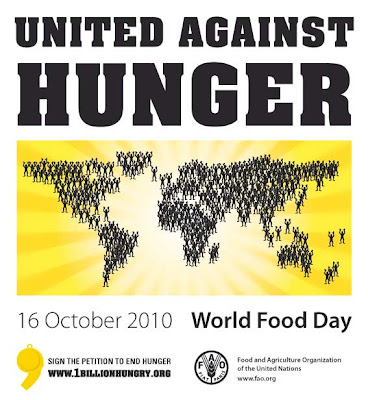
THIS POST SERVES TO MARK
to-day
16 October.
is hosting a blogging event
of which this post will form part.
Click to enlarge
On Tuesday 6 October, Belinda, her friend Susan (from Permaculture circles), and I tripped down to West Gippsland for a food, farmiing and health conference titled
"Nurture the land, Nourish the people..."
This conference was absolutely brilliant.
Sue Webster of Agribusiness Gippsland
with her band of helpers
did a marvellous job and showed us
true Gippsland hospitality.
Now below are not my words.
I didn't want to re-invent the wheel.
Sue, in a previous incarnation, was/is a professional journalist.
She precis-ed the conference well in
the latest edition of
Gippy AGchat.
The conference was such an action packed day
I'm not sure if I could report adequately.
Belinda, Susan and I learned heaps.
Networked with lots of interesting people
There were three workshops -
and we were able to divvy these up between us
so we had plenty to chat about on the drive
back to Melbourne.
Conference serves up innovation banquet
Food grown on city wasteland to curb carbon, a Landcare-type movement to save our soils and a Victorian Ministry of Food … those were some of the innovations raised at the ground-breaking Food, Farming and Health conference held in Warragul last week.
About 150 people from interstate and across Victoria came to share visions of nurturing the land while nourishing its people.
The conference, organised by Agribusiness Gippsland, saw speakers from NSW and across Victoria addressing farmers, landholders, water and Landcare representatives, health professionals, teachers, shire and other government delegates.
“It was astonishing how readily these quite-separate groups came together,” said Alex Arbuthnot AM, chair of Agribusiness Gippsland. “It proves that the same issues are top-of-mind across all these sectors.”
Across the audience there was a lot of note-taking going on. During the breaks the buzz of networking was notable. Attendees overwhelmingly returned glowing evaluation forms and many sought another conference next year.
Keynote speaker
Andrew Campbell demanded an ‘intersection’ of health policy and agricultural practice for the good of the earth, and the people depending on it.
“We’re not talking climate change but climate chaos,” he warned. “We need to decouple economic growth from carbon emissions; we should shift from fossil fuels to renewable energy. We have to increase our water and energy productivity.
“For example, growing corn to produce ethanol makes no sense at all, it requires more energy input than it produces.” (Longer report below)
The State Nutritionist Veronica Graham shared unpublished data showing that the price of healthy food, such as vegetables, fruit and grains had risen about 20% since the introduction of GST, higher than the rise of ‘non-core’ food. “So if you’re trying to eat healthy food that is an issue especially if you’re on a limited income,” she said.
She also expressed concerns about the loss of farmland to housing. “Urban development is displacing food production, for example at Werribee. This is about policy or land planning and I don’t know the degree of control, but it is concerning.”
DPI deputy secretary Bruce Kefford detailed some of the opportunities ahead for agriculture including GPS for more precise tilling, GM for less fertiliser and chemical applications and modifications to feed to curb greenhouse gas emissions.
“We need to accelerate change,” he said. “Farmers get demonised and I don’t think that’s fair or smart. They’re already part of the solution.” (Longer report below)
Sue Brumby, Director of the
National Centre for Farmer Health, warned of the looming “tsunami” of diabetes, especially in rural areas. In
Loddon Shire, for example, one person in 10 suffers from the condition.
She praised the conference organisers, led by Gippsland beef farmer Jenny Sullivan.
“It’s just fantastic to see a conference like this,” Ms Brumby said.
Her praise was echoed by
Prof Linda Tapsell of the University of Wollongong. She had declined an overseas speaking engagement to attend the Warragul event.
“The situation you now face is for this small region to put it all together and see if you can do something about it,” she told the audience.
The full-day conference included a range of other speakers discussing, among other things:
• Food gardens reclaimed from urban waste ground or roof tops.
• Declining reserves of phosphorus, the world’s major agricultural fertiliser.
• How two people feed 50 families from an acre in Healesville.
• The hazards and heartbreaks of establishing an organic retail business.
• The need to grow pest predators to replace chemicals.
“And much else besides,” Mr Arbuthnot added. “And the day featured a Gippsland- sourced, healthy lunch – proving you eat what you are and you are what you eat!”
The conference was funded by
VicHealth, Baw Baw Shire Council, the
DPI, DSE and
West Gippsland CMA.
~~~~~~~~~~~~~~~~~~
Vision, cohesion and revolt needed: Campbell
Policymakers have left Australia’s rural communities ‘way exposed’ Andrew Campbell told the conference.
The keynote speaker said: “We haven’t created the right frameworks in research, policy and education we’ve left our rural communities way exposed. Our cross-system learning across the boundaries is very, very poor and the general literacy is abysmal across bureaucracy and across corporate boardrooms
“I think we need to revolt direct action at a local level and showing lots of little candles in the darkness, that’s the most powerful thing we can do. You need to use the media and engage some celebrities. In my view there’s a lot of the jigsaws there and these are more likely to be put together coherently at the local level.”
During question time Malcolm Cock, a beef farmer from Hallston asked if it could be possible to decouple food production from economics.
Andrew replied: “I can’t see how we can get economics out of anything, frankly. That’s the system we’re in. But the bigger challenge we’ve got is making the market economics more closely reflect the energy reflected in the price, the more we can get a real price paid by the consumers. I believe food prices need to go up very substantially, although we need to look at that from an equity point of view.”
Considering future development, he said: “It’s a nonsense not to have an integrated approach for transport for water and for power. No one’s going to plant biofuels if they don’t know where the processing plant will be. And no one is going to build a plant if they haven’t security of supply, and then both need transport … we need to integrate all these things. Silos of information exist but agriculture, health and environmental policy should intersect and that’s where we should be putting resources, that’s why this conference is so important.”
He praised the conference for “seeing agriculture as part of the food system and consequently part of the health system and seeing how those things all link together.”
Carbon’s role in the future food supply menu
Anyone planning to supply cost-competitive foods to the future marketplace will have to be a low-emission operation.
Climate change is going to change the economics of food production and delivery, according to an industry expert.
Kirsten Larsen, from the University of Melbourne’s
Victorian Eco-Innovation Lab, said In Australia food accounts for 28% of all greenhouse gas emissions. “And that doesn’t include cooking or transporting foods,” she added. That figure compares with 20% from heating and energy outputs and 10% from transport.
She noted that urbanisation is pushing food production further from markets, requiring more freighting. “Emissions from freight are increasing faster than most sectors,” she said. “About 12% of total tonnage is for food and food is travelling further than most other things. In addition fertilisers constitute about 15% of the total weight of what’s travelling through the transport system.”
Other challenges facing food production in the future include shortages of land and fertiliser. There were reports, she said that phosphate rock supply might have peaked.
“If we want to feed 9bn people how much grain will be fed for animals and how much for people. What will we use our land for and who gets to eat? Assuming a linear increase in meat consumption is not going to be coherent with response to climate change,” she warned.
The answer to these could lie with what she described as “food-sensitive urban design” or “how do we produce food in cities for people who live in cities?”
She noted rainfall lost to runoff and organic waste lost to landfill as potential reuseable resources.
She offered examples in the US of small vegetable plots in urban wasteland and of
commercial rooftop horticulture in New York.
She also suggested community-supported agriculture, where consumers transact with farmers more directly – even to joint ownership or leasing deals. “Farmers are carrying a lot of the risk and farmers are the price takers. How do people in the city support this? The community-supported agricultural model might help,” she said. “There’s lots of exciting things happening on the ground but how do we pull this together to get a clear message to government?”
Changes to make gains: DPI boss
Bruce Kefford, the DPI’s deputy secretary scored a lot of approvals in the end-of-day evaluation forms with his vision of farming in the future.
He stressed the opportunities available amid challenging change.
Among the highlights he listed were the use of GPS for pinpoint sowing, fertiliser application and weed control, greater irrigation and water use efficiencies and integrated pest management – using bio-enemies such as competing organisms or buffer crops.
Acknowledging opposition, he also praised research into GM. “It offers some tremendous opportunities when safely and legally used to solve some problems,” he said. He offered the example of research investigating inserting rust resistant barley genes into wheat.
“If there’s no rust on wheat we won’t have to use chemicals,” Bruce said. “This is the sort of benefit we can achieve. The way we get some of our best insights is to go to nature and get some ideas into how to solve a problem.”
He also praised work on methane reduction in ruminant animals. “To my complete surprise I found we have worked out, from our early work on feeds, that we can reduce methane and increase yield,” he said. “We’ve dropped the methane production of cows by 20% and increased production and we haven’t even looked at how the rumen of the cow can be modified.”
He added: “The most important thing we can do is provide a range of healthy foods”, specifying grains of lower GI and leaner lambs.
“We need to accelerate change,” he said. “Farmers get demonised and I don’t think that’s fair or right. They’re already part of the solution.”
During question time, he was asked his thoughts of giving agriculture a wider scope – and possibly a bigger labour catchment – by renaming the Department of Primary Industries the Department of Food.
He replied: “We’re a sector that’s more comfortable quietly getting on with the job and that brings with it the cost of being undervalued. This could be working against us.”