Showing posts with label Infrastructure. Show all posts

Tuesday, 3 December 2013

The REAL need for NBNCo and Fibre To The Home. Is all lost for people who really need FTTH? The National Party's enthusiasm for internet equity has evaporated.


Picture from here

A plea from my Facebook friend

I am a Pensioner confined to my home with a debilitating muscular disease and I NEED access to the world through my computer and TV! The only way I can get this with any real benefit is through FTTH Broadband! -- http://www.avaaz.org/en/petition/Malcolm_Turnbull_MP_Minister_for_Communications_in_the_Australian_Governme_Roll_out_FTTH_so_people_can_watch_4K_TV/?fbdm
!!!!!!!!!!!!!!!!!!

At first glance the slogan on this ad - Bringing broadband to life - seems to refer to the quality of the broadbard that NBNCo plans to deliver.  I'm sure that this the intention.  However, let's turn it on its head.  Let it read Bringing broadband to ... life.

NBN is important to people who are not geeks, not cheap film seekers, not internet speed hogs.  There are people who need NBNCo because of their health: their physical health needs; their mental health needs; to get clear and swift diagnoses; to access 21st Century health care while living in isolated and rural areas.  

Such needs are too important to be politicised.

As a postscript, I recall when I lived in a very remote area of north-west Queensland, the National Party was giving priority to computer and internet access for people in rural areas.  Local National Party activists were campaigning.  I have seen television news stories on the benefits of NBNCo to rural businesses, to education and health services in rural Australia.  

In the 21st Century, I have not heard a word from the National Party in support of NBNCo and its access to high-speed broadband.  It seems that the enthusiasm of the early 1980s for equity in access to the internet for people in rural and remote areas has evaporated.  There seems to be only one explanation - partisan politics.  The NBNCo and its project for Fibre To The Home - not Fibre To The Node - has disappeared into a political abyss instead of being held up as a recognition of social equity.

More
Turnbull to defy Senate order to produce NBN report


Monday, 20 December 2010

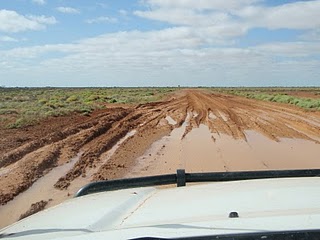
Rural roads - but what about Aboriginal communities & The Outback. #aboriginal #indigenous #agchatoz #roads


I love it when well-resourced individuals in main stream society start whingeing (ahem, complaining) about occasional matters in their life that ignored individuals, businesses, and communities in remote Australia put up with regularly.  

'I love it' is meant two ways.  Firstly, there's my cynical self. Second, there's the self that thinks - OK this time it might hit some sort of useful place from which to springboard into an actionable place.

This article about farmers getting stuck on muddy bush roads is a case in point.

Please note a few things about this article:
  1. Where. Look at where the people the article quotes come from.  They come from northern New South Wales. Please note the central part of northern NSW. They do not come from dry, dusty, isolated outback NSW. The first spokesperson is Deputy Mayor of Moree Plains Shire Council. She is also Deputy Chair of the Australian Rural Roads Group.
  2. Who. The other person quoted is significantly involved in his region.  Significant enough to chair a local floodplain management committee. and to give a testimonial for some agricultural machinery. One assumes he is also a member of the Grain Growers Association
  3. How. The Australian Rural Roads Group has got its act together - and clearly some dollars, as well - and has published a report called Going Nowhere. You, dear Networkers, can download it above.
Now the tone of what I have written above sounds cynical.  I have written in this tone to emphasise the point I wish to make.  

I am supportive of the organisation and ideas behind Going Nowhere.  I have lived too long in remote Australia to do otherwise. I also realise every great movement has to start somewhere.   One has to look, however, at the gaps and begin to move into them - which I hope,  with this post, to encourage the Australian Rural Roads Group to do.

So let's look at the gaps.

Firstly, I am pleased to see that the cover photograph has been contributed by my blogging buddy, Robbo of Bite The Dust fame.  You can also find him in more up to date fashion on Twitter. As you can see from Robbo's photo and the Wreck of the Week feature on his blog, roads certainly have their moments out where he lives in the Gibson Desert.  You will note the isolation of that bit of Australia marked in red.

Now go to the map in the Going Nowhere report. The most isolated and remote parts of Australia, including Robbo's domicile, are not give the green of participation.  

And to give some information and a big dose of reality, let me take you to my old stomping ground of the Barkly Tableland which is in the Northern Territory and slap bang in the middle of the Australian continent. Ali Curung is a significant Aboriginal community in the Barkly Shire and you can read about it here. Please note the second last sentence.
Ali Curung is fortunate to have a bitumen road to the community. During the wet season the main road to Ali Curung is usually open to traffic, however dirt roads connecting outlying communities are often unusable.
You see, bitumen roads to Aboriginal communities are remarkable.  Sometimes, to travel to an Aboriginal community in the NT, it may be bitumen most of the way such as scooting along the Stuart Highway.  Then the last few kilometres to the community are dirt - as if to reinforce the second-class status of Aboriginal citizens living in communities.

Go a bit further down the highway to the Epenarra turn-off.  This is the situation there.  Note the picture in the top left hand corner.

Now, I don't know what you think Networkers (you might let me know), but it seems to me that to have a lively economy - small, medium or large - an all weather road is needed.  That is what the Australian Rural Roads Group is saying too. 

Noel Pearson is fond of lecturing Australia on the need for Aboriginal people to move away from welfare dependency. Long before the majority of Australians ever knew of Noel Pearson, Aboriginal communities in the Northern Territory - and other places too - were trying to do just that.  They were forming businesses. Some were pastoral, some were agricultural, some were tourism based.  Some succeeded - and some have succeeded marvellously.  Some have not.  For Aboriginal businesses and communities, what a difference an all weather road can make.

Without all weather roads, Aboriginal communities can be cut off - not only from developing a vibrant local economy but from accessing business and personal services such as health, education, local government expertise and so on.

In short, when we hear the agenda of Aboriginal needs in the Northern Territory, roads don't get a guernsey.  


The Intervention was founded on halting child abuse.  The doctors found an infinitesimally small number of possible cases. Think about the energy and funding put  into The Intervention with what might have been the case if the same amount of energy and funding had gone into infrastructure such as roads and citizenship entitlements which other Australians take for granted. 


Then something might have been achieved to benefit Aboriginal people, their communities, and the nation.

Thursday, 9 September 2010

Sydney or The Bush: Reframing the debate: Access, equity, a fair go: Sanderson - Federal renewal and unity in reconcilation


Seems that hell hath no fury like a major urban area scorned!

Now I could read all sorts of things into the musings I am about to draw your attention to,Networkers.  Perhaps, they are the Fairfax equivalent of News Limited braying for an early election? Perhaps, these are individuals who just don't like what the independents have been doing and how they have been negotiating with the Australian Labor Party?  But my money is on them being short-sighted, urban creatures who don't have a clue about the Australia that exists away from the urban fringes.  In short, I think they are overcome by their own ignorance.

First Shot -
Second Shot - 
Let's take a look at the First Shot, Clancy Yeates.

Tut-tut, Clancy.  Don't look too closely at who might be subsidising your urban lifestyle.  The West Australians think they are.  In fact, there have been recent comments on subsidies for Melbourne's arty, cultured lifestyle which continues though we are not manufacturing anything much anymore.  Sydney seems to think we are diverting their much needed funds.  The fact is that the really productive earners at the moment are in remote areas of Australia far from urban centres - and a lot of them are on the other side of the continent from the fringe-dwellers of the urbanised eastern and southern coasts.

And what is the problem with cross-subsidisation, Clancy?  Are you so imbued with Friedman and neo-con economics that you can't get your head around the tried and true economic concepts of equity and price-equalisation.  It was the way Telstra operated until recent times - and look where the concepts behind the changes to Telstra have landed the nation and Telstra shareholders!

Lastly, I would remind you that NBN has clearly built its business model on a system of equitable pricing.  Now business models can be built like Lego - anyway you darn well like to put the pieces together!  The two things necessary are, firstly, to be seen to give your market a good deal so they will purchase and keep purchasing your product; and, secondly, to turn a profit for those who have invested in the company.  How this is done is really a moot point.  The proof of the pudding is in the eating.  The pricing and the costings work - or they don't.  So, in this case, where a whole way of doing things is being built in a novel and innovative way from the ground up - so is the pricing mechanism.  

Now for the Second Shot, Anita Quigley

I don't take issue with the comments about Rob Oakeshott who, we might find, is the wily politician (or not so wily, as the case may be) that the headline asserts.

What I do take issue with are comments like these:

Imagine how western Sydney residents are feeling today - an area of the country growing rapidly in population and desperately needing infrastructure such as basic public transport to cope. Yet the bigger more pressing issue for the new federal government will be ensuring a far smaller population gets 24k gold-plated fibre optic cable for high speed broadband.
The fact those in the country will be able to have better internet services is sure to console commuters who have to drive 90 minutes each way to work while paying about $80 in tolls a week for the privilege.
I do have empathy for those living in the western suburbs not only of Sydney but of Melbourne too.  Melbourne complains about its public transport but, in my experience, it does not compare with Sydney's - and life is too short to spend any of it on Sydney's City Rail.  But Anita, let's spare a thought for the rural and regional areas of Australia.

Few areas of regional and rural Australia have a reliable public transport system.  Some don't have any public transport whatsoever.  A large regional centre like Townsville which Anna Bligh has mentioned as a "second capital city" for Queensland no longer has a functioning suburban rail system nor - when it would make good sense - an extra-urban system to places like Charters Towers, Bowen, Ingham and Cairns.  Further into the back blocks, and you will find some Aboriginal communities have no way out except by light aircraft.

As for infrastructure!  Some parts of Australia do not have reliable, clean drinking water. 


For all the talk of of getting Aboriginal people off welfare and into a functioning economy, please show me a human settlement in Australia with a strong functioning economy that does not have a bitumen road in and out of it.  


The majority of Aboriginal communities in the Northern Territory are serviced  by dirt roads which are impassable in The Wet.  This means there is difficulty accessing professional health, education, and business services all year round.  In The Wet, the only way in and out of many communities is by plane.  When you don't have a serviceable road at all, the discomforts and lack of service by City Rail and Metro pale into insignificance.

And take a look at health services.  No Westmead or Liverpool Hospital within striking distance.  In Victoria, which is so small that even its outback is suburban, hospitals - like the one in Echuca - have their problems and have difficulty getting funds out of the public purse.

And, I have to ask, how much knowledge is there in Western Sydney of the deprivations of those living in more sparsely populated Australia?  How much empathy is there in Western Sydney for those in remote areas who don't get the attention they deserve from their governments?  Very little of either, in my experience.  

But to all those who think that urban areas have been hardly done by just to favour a few bush politicians and get a party over the line to government, I am including below the best piece of writing I have seen in recent times on how tough people in remote areas are doing it.


On the Queen's Birthday weekend in June 2007, the annual oration of the Order of Australia Association was given by Lieutenant-Colonel John Sanderson, the former Governor West Australia.  It was titled Federal Renewal and Unity in Reconciliation: a return to government by the people.


Since getting hold of this document in June 2007, I have tried to circulate it as widely as possible to people who need to know its contents or whom I think would be interested in its contents.  I think, given the current political context, a reading of Sanderson's oration is more necessary than ever.


Lastly, let's take the opportunity to reframe the debate in this country: on politics, on economics, on population, on development.  Back in the Keating era some basic criteria were introduced into the bureaucratic implementation of public policy.  The criteria were access, equity, and a fair go.  If you have these three criteria operating, then there will be inclusion.  If inclusion is promoted, you will need to implement these three basic criteria.


I don't want to play off Sydney or The Bush.  I want everyone in Australia to be treated fairly according to their needs and their circumstances.  


Now this doesn't mean that everything can be done at once for everyone.  It doesn't mean that The Bush and The Push will get equal divvies of the Federal and State Budgets.  There are times when a substantial injection of funds and resources are needed to establish infrastructure projects.  


To overcome alienation of either The Bush or The Push, we need politicians and bureaucrats who understand modern community engagement; who can communicate and converse with Australians.  We need politicians and bureaucrats who can take Australians into their confidence, admits mistakes and difficulties, seek widespread and diverse input.  Conversely, The Bush and The Push need to act in a mature and reasonable fashion.  They need to get their collective heads around their respective issues and be able to articulate their needs and aspirations in a clear and particular fashion to governments.


We need to take seriously the need to reframe the debate across all our communities so that, as Oakeshott says, we are focussed more on agreement than division and more on constructive outcomes than self-serving politics.  When we are tempted to make partisan pronouncements, let's have a think first.   Let's state our case for our own needs and aspirations without diminishing other Australians or over-stating our own case to turn it into special pleading.  


Let's reframe the debate so that when we deal with our governments it is all about access, equity and a fair go.


Enhanced by Zemanta

Total Pageviews