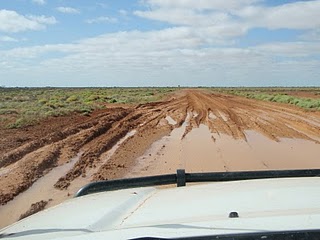
I love it when well-resourced individuals in main stream society start whingeing (ahem, complaining) about occasional matters in their life that ignored individuals, businesses, and communities in remote Australia put up with regularly.
'I love it' is meant two ways. Firstly, there's my cynical self. Second, there's the self that thinks - OK this time it might hit some sort of useful place from which to springboard into an actionable place.
This article about farmers getting stuck on muddy bush roads is a case in point.
Please note a few things about this article:
- Where. Look at where the people the article quotes come from. They come from northern New South Wales. Please note the central part of northern NSW. They do not come from dry, dusty, isolated outback NSW. The first spokesperson is Deputy Mayor of Moree Plains Shire Council. She is also Deputy Chair of the Australian Rural Roads Group.
- Who. The other person quoted is significantly involved in his region. Significant enough to chair a local floodplain management committee. and to give a testimonial for some agricultural machinery. One assumes he is also a member of the Grain Growers Association
- How. The Australian Rural Roads Group has got its act together - and clearly some dollars, as well - and has published a report called Going Nowhere. You, dear Networkers, can download it above.
Now the tone of what I have written above sounds cynical. I have written in this tone to emphasise the point I wish to make.
I am supportive of the organisation and ideas behind Going Nowhere. I have lived too long in remote Australia to do otherwise. I also realise every great movement has to start somewhere. One has to look, however, at the gaps and begin to move into them - which I hope, with this post, to encourage the Australian Rural Roads Group to do.
So let's look at the gaps.
Firstly, I am pleased to see that the cover photograph has been contributed by my blogging buddy, Robbo of Bite The Dust fame. You can also find him in more up to date fashion on Twitter. As you can see from Robbo's photo and the Wreck of the Week feature on his blog, roads certainly have their moments out where he lives in the Gibson Desert. You will note the isolation of that bit of Australia marked in red.
Now go to the map in the Going Nowhere report. The most isolated and remote parts of Australia, including Robbo's domicile, are not give the green of participation.
And to give some information and a big dose of reality, let me take you to my old stomping ground of the Barkly Tableland which is in the Northern Territory and slap bang in the middle of the Australian continent. Ali Curung is a significant Aboriginal community in the Barkly Shire and you can read about it here. Please note the second last sentence. Ali Curung is fortunate to have a bitumen road to the community. During the wet season the main road to Ali Curung is usually open to traffic, however dirt roads connecting outlying communities are often unusable.
You see, bitumen roads to Aboriginal communities are remarkable. Sometimes, to travel to an Aboriginal community in the NT, it may be bitumen most of the way such as scooting along the Stuart Highway. Then the last few kilometres to the community are dirt - as if to reinforce the second-class status of Aboriginal citizens living in communities.
Now, I don't know what you think Networkers (you might let me know), but it seems to me that to have a lively economy - small, medium or large - an all weather road is needed. That is what the Australian Rural Roads Group is saying too.
Noel Pearson is fond of lecturing Australia on the need for Aboriginal people to move away from welfare dependency. Long before the majority of Australians ever knew of Noel Pearson, Aboriginal communities in the Northern Territory - and other places too - were trying to do just that. They were forming businesses. Some were pastoral, some were agricultural, some were tourism based. Some succeeded - and some have succeeded marvellously. Some have not. For Aboriginal businesses and communities, what a difference an all weather road can make.
Without all weather roads, Aboriginal communities can be cut off - not only from developing a vibrant local economy but from accessing business and personal services such as health, education, local government expertise and so on.
In short, when we hear the agenda of Aboriginal needs in the Northern Territory, roads don't get a guernsey.
The Intervention was founded on halting child abuse. The doctors found an infinitesimally small number of possible cases. Think about the energy and funding put into The Intervention with what might have been the case if the same amount of energy and funding had gone into infrastructure such as roads and citizenship entitlements which other Australians take for granted.
Then something might have been achieved to benefit Aboriginal people, their communities, and the nation.