Showing posts with label Hunger. Show all posts
Showing posts with label Hunger. Show all posts
Monday, 18 March 2013


Wednesday, 6 March 2013
Swiss company evicts farmers for biofuel
From CorpWatch:
Sierra Leone Farmers Evicted
for Sugarcane Biofuel Plantations
by Jennifer Kennedy, CorpWatch Blog
March 5th, 2013
Sierra Leone Farmers Evicted
for Sugarcane Biofuel Plantations
by Jennifer Kennedy, CorpWatch Blog
March 5th, 2013
The Makeni project in the Bombali and Tonkolili districts of western Sierra Leone was initiated in 2008 on land acquired by Addax, a subsidiary of Oryx, an energy corporation founded by Swiss billionaire Jean Claude Gandur. Sugarcane grown on 10,000 hectares of land will be processed in a neighboring ethanol refinery and a biomass power plant to deliver a total of 100,000 megawatt hours of power for export to Europe once all the infrastructure has been completed later this year. Addax has planted the fast growing sugar cane on large areas of productive land known as the bolilands even though it promised not to, alleges SiLNoRF’s in its 2012 annual monitoring report. “[Addax] has taken away most of the bolilands and the people, they are saying that they have been stolen from them,” Abass J. Kamara, programmes coordinator for SiLNoRF, told CorpWatch. (The company has a 50 year lease for a total of 57,000 hectares of land in Sierra Leone. "Now I don’t have a farm. Starvation is killing people. We have to buy rice to survive because we don't grow our own now," one community member told Canadian journalist, Joan Baxter at an April 2012 farmers' conference organized by SiLNoRF and Green Scenery, another Sierra Leonean civil society organization. For Sierra Leone, a small West African nation that ranks as one of the poorest countries in the world, which is slowly emerging from a brutal civil from war that displaced about half of its population from 1991-2002, this issue of food security is a major national problem, according to the Oakland Institute, a U.S. based think tank. The current government headed by President Ernest Bai Koroma has favored the introduction of industrial farming as a way to meet this challenge. For example, in 2009, the government created the National Sustainable Agriculture Development Plan (NSADP), to “increase the agriculture sector’s contribution to the national economy by increasing productivity through commercialization and private sector participation.” The Makeni project, which has been touted as the country’s ‘flagship investment’ for agricultural development, has received €142 million in loans from several European development banks such as the Netherlands Development Finance Company (FMO) and the German Development Finance Institution (DEG – Deutsche Investitions- und Entwicklungsgesellschaft mbH). Included in the list is the UK’s Department of International Development (DFID) sponsored Emerging Africa Infrastructure Fund (EAIF). In order to resolve the conflict with local farmers who have relied on the land for generations, Addax ‘lured’ community members into signing away their land to Addax with‘juicy’ but non-binding promises to build schools, medical facilities, and community centers, alleges Bread for All. Kamara noted that the communities’ right to “free, prior and informed consent” had been violated because Addax had only talked about positive changes, neglecting to mention any of the project’s possible negative impacts. Addax also set up an alternative farming mitigation project called the Farmer Development Program (FDP) but this has failed to provide adequate long-term food security for impacted farmers so far, according to a joint report by SiLNoRF and Bread for All published in September 2012. A key stumbling block is the fact that farmers have to pay the full cost of seeds, harrowing, and ploughing on this new land after just three years which SiLNoRF says will be hard. For example Kamara told CorpWatch that “farmers are confined to smaller portions of land and they are being encourage by Addax to use mechanized methods of farming like fertilizers and other pesticides and these people cannot afford to pay for them.” Although Addax pays compensation of $12 per hectare per year to many of the community members, an “Independent study report of the Addax Bioenergy sugarcane-to-ethanol project in the Makeni region in Sierra Leone” published by SiLNoRF says that this is not a “fair and adequate amount’” as it would not be enough to purchase a single meal in the province’s regional capital of Makeni.Responding to the publication of the SiLNoRF study, Addax said that it “vigorously contests the allegations contained in the strongly biased report which neither reflects the reality on the ground nor takes any notice of the unprecedented efforts deployed on the ground to engage with local communities and improve their daily lives.” NGOs blame the development agencies for having created this conflict. A report titled ‘The Hunger Games' published by War on Want, a UK NGO, alleges that DFID has used taxpayers’ money to support “land grabbing” in Africa by supporting big agribusinesses over millions of subsistence farmers, condemning the latter to poverty. War on Want points out that DFID helped finance the creation of the Sierra Leone Investment and Export Promotion Agency (SLIEPA) in 2008, which has been aggressively promoting foreign investment” that has resulted in some 500,000 hectares of land being acquired by foreign corporations, according to SiLNoRF. Addax is not the only company which has been accused of land grabbing in Sierra Leone. In the southern district of Pujehun, land disputes are also simmering between local famers and Socfin Agricultural Company Sierra Leone Limited, a subsidiary of Socfin Group which is majority owned by the French investment and holding conglomerate, Bolloré Group. Despite promised benefits, many families are vehemently opposed to the leasing of their farmland for rubber and oil plantations, according to Green Scenery, a Sierra Leonian NGO. |

 |
Tuesday, 27 December 2011
World trade - Food Security - Local Food Systems
Thank you to Dale Hess for drawing attention to this:
 At a World Social Forum event in 2006, Walden Bello warned that the Doha Round of the World Trade Organization (WTO) was careening down a track to disaster. Civil society needed to insist that negotiators pull back before the Round went off a cliff, the founder of Focus on the Global South said.
Food security and the WTO
Olivier de Schutter
Although the global economy has certainly changed since then, the WTO seems stuck on the same track. The WTO ministerial last week in Geneva unsurprisingly failed to change course, perhaps most visibly on the issue of trade and food security. In a lively debate WTO head Pascal Lamy and UN Special Rapporteur on the Right to Food Olivier de Schutter highlighted the need for a fresh approach. De Schutter argued that the WTO was holding food rights “hostage.” Lamy, though agreeing that “governments have a sovereign right to pursue policies to achieve food security within their international obligations,”maintained that countries should not limit international trade to achieve this objective.
This tension between trade and food security has emerged as a key dividing line in international negotiations at the WTO. There are, however, ways to transcend this debate and make real progress in feeding hungry people and preserving the livelihoods of farmers.
Dumping at Doha
In 2006, the major issue in negotiations on agricultural trade was dumping -- the export of agricultural goods at below the cost of production – and the problems created when floods of cheap imports overwhelmed local farmers and their markets. Developing countries, led by the G33, pushed back with proposals for temporary protections in cases of import surges (Special Safeguard Mechanism) and exemptions for certain goods that were key to food security and rural livelihoods (Special Products). There was strong pressure on the United States and EU to reduce agricultural subsidies and export subsidies, and change other policies that have contributed to overproduction and low prices. As the negotiations dragged on over the next few years, the failure to reach an agreement on agriculture contributed to the ultimate collapse of the talks in 2008.
By mid-2008, dumping was no longer the main problem, because food prices were soaring and food riots were erupting in country after country. This, along with the financial crisis and growing awareness of the looming climate catastrophe, led to a series of dialogues at the local, national, and global levels on how to rebuild fragile food economies and rural livelihoods. The decades-long accepted wisdom that countries should rely on global markets for food supplies was overturned, and countries around the world began to re-invest in national food production. Trade would still remain a component of food and agriculture systems, but it would serve as the backup plan if domestic production fell short, rather than as the foundation of food security.
Nevertheless, the WTO talks have continued to operate as if little had changed, chugging along with proposals to continue to lower trade barriers and to limit support for agricultural production to measures unlikely to distort trade prices and volumes. Calls for the completion of the Doha Round, once a staple of international gatherings of world leaders, have become ever fainter. By the November 2011 G20 meeting, the heads of state stepped back, saying,
We stand by the Doha Development Agenda (DDA) mandate. However, it is clear that we will not complete the DDA if we continue to conduct negotiations as we have in the past. We recognize the progress achieved so far. To contribute to confidence, we need to pursue in 2012 fresh, credible approaches to furthering negotiations...
Failure in Geneva
The lack of fresh ideas contributed to the low profile and low expectations at the WTO ministerial last week in Geneva. Efforts by Egypt and the EU to include some discussion of food security, particularly assurances that emergency purchases by the World Food Program would not be affected by export bans,were dropped just days before the talks. Olivier de Schutter called for measures to reorient WTO rules to remove constraints to the right to food, including the establishment of a protocol to monitor the impact of trade on food prices and a general waiver to exempt food security-related measures from the WTO disciplines without penalty. WTO Secretary Pascal Lamy dismissed his proposals, calling instead for deeper reliance on volatile and unpredictable global markets.
Trade remains a critical issue in global food systems. The question is not between autarky and unrestricted free trade. It is about the nature of the exchanges, who controls the agenda, and what the rules should be. Trade policy is broader than the proposals currently on the table, just as the WTO as an institution will not collapse if the members finally agree to abandon the Doha Round.
Developing countries need rules that provide the policy space to determine the best mix of agriculture and trade policies to support rural livelihoods and food security. It will also be important for developed countries to create the right agricultural policies to prevent dumping and create an enabling environment for a transition to sustainable agriculture and strong rural economies. Payments to EU and U.S. farmers have dropped in recent years as commodity prices have risen, and there is substantial budgetary pressure for additional cuts. Simply cutting spending, however, will not restore stable agricultural markets. A recent study by the University of Tennessee’s Agricultural Policy Center concluded that if the United States had had a reserves program in place during over the last 13 years, expenditures would have been reduced by 40 percent, while farm incomes and prices would have been much more stable. In an era of tight budgets and unstable food supplies, proactive programs for reserves, as well as efforts to curb excessive speculation, could contribute to more stable markets in support of food security.
Limiting Trade, Expanding Food Security
In view of the deadlock in the WTO talks, governments could take actions now to begin negotiating the terms of a limited role for trade in achieving food security, rather than to continue to advance complete market access for transnational agribusinesses at any cost.
They should, first of all, affirm developing countries’ rights to control their markets to achieve food security. The World Bank, USAID, and other donor institutions have acknowledged that previous policies that undermined local agricultural production and overemphasized the role of the private sector – especially in Africa -- were a mistake and have increased spending to rebuild domestic production, processing, and distribution capacity. Continuing to insist on further liberalization of trade is also a mistake. Farmers need clear, predictable signals and support to increase food production and establish stable local markets. Developed countries should explicitly affirm the right of Least Developed Countries (LDC) and Low Income Food Deficit Countries (LIFDC) to exclude Special Products such as rice, beans, and other essential foods from any trade liberalization. LDCs and LIFDCs must be able to take measures to rebuild production and market infrastructure in basic foods free of the threat of retaliation in trade disputes. Those countries should also be explicitly excluded from trade promotion goals pursued by the United States and other developed nations. De Schutter’s proposal for a food-security waiver from WTO commitments could be the basis for such an approach.
New programs can help calm volatile markets. Current WTO rules allow for a certain degree of flexibility to implement food reserves programs, and the G20 recently called for a pilot program to implement emergency reserves in West Africa. This should be expanded to normalize and support countries’ investments in stocks that cushion against disruptions in world markets and global supplies. WTO members should carve out space to support such efforts and develop plans to allow for the establishment of state-owned enterprises to manage such programs. They should also encourage the expansion of agricultural spending in developing countries beyond current limits established in WTO rules.
Agricultural support, meanwhile, can help to promote stable food supplies. Rather than starting from a default position that any subsidy must minimize distortions to trade, definitions of the kinds of subsidies permitted under global trade rules should be carefully revised to best encourage a transition to sustainable agriculture, strong rural economies and adequate food supplies.
Finally, no WTO, Free Trade Agreement or Bilateral Investment Treaty on procurement and investment should conflict with programs to develop healthy local food systems. Both hunger and obesity rates are increasing around the world. The plurilateral Global Procurement Agreement, although limited to 42 countries for the time being, could potentially limit innovative approaches to reform national food systems that include school feeding programs and related initiatives that favor local procurement of fruits, vegetables and other healthy foods. Similarly, investment protections in bilateral investment treaties and bilateral trade agreements could undermine local or national programs to set the conditions for appropriate investments in the production of healthier, more sustainable foods for local markets. Parties to those talks should establish broad exemptions to advance food security and sustainable development.
Rebuilding sound food systems requires a clear look at what is working on the ground, and how to build up from there. Trade is a complement, not a substitute, for national food systems. The WTO should stop insisting on an agenda that was already out of date when it was first broached over a decade ago. It should get back on track – or get out of the way -- to support fresh approaches that bolster local food systems.
Monday, 11 October 2010
GM Free Week of Action: World Food Day: United Against Hunger

Picture from here

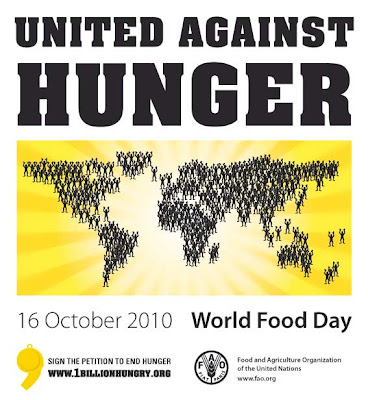
This is the GM Free Week of Action and, if you pop over here, you will find that Jessica Harrison has provided all sorts of information to keep you on the go and committed.
SPEAK OUT AGAINST MONSANTO
Friday 15 October 2010
Meet at Flinders Street Station, Melbourne
Under the Clocks
One of the things the Week of Action does is act as bridesmaid and usher in the really big United Nations event, World Food Day organised by the Food and Agriculture Organisation (FAO).
FOOD COMPANY LOBBY DAY
Wednesday 13 October 2010
Take 3 minutes out of your busy day
to email or phone the big food companies -
telling them
"We want our food to stay GM free".
- To ask Pfizer/Wyeth for an immediate recall of GM contaminated infant formula S-26 Soy, ring their toll free number 1800552229
- To lobby Health Minister Nicola Roxon asking her to fix our "rigorous" labelling laws so they really protect us.
- http://www.greenpeace.org/australia/issues/GE/taking-action
- Contact Woolworths on 1300 767 969 http://www.woolworths.com.au/wps/wcm/connect/website/woolworths/contact+us/ contact-us
- Contact Coles: 1800 061562 or http://www.coles.com.au/Coles/Coles-Feedback.aspx
- Other companies http://www.truefood.org.au/takeaction/?action=FOODCO
- Lobby the WA Agriculture minister on GM wheat at http://www.geneethics.org/actnow
Free copies of the 2010 True Food Guide
which lists the companies committed to keep
their products GM free
are available from
support@au.greenpeace.org or 1800815151
Friday 15 October 2010
Meet at Flinders Street Station, Melbourne
Under the Clocks
Monsanto has begun a campaign to "change the opposition many Australia consumers have to genetically modified food". If you feel outraged, come along to speak on the open microphone and hear speeches from La Via Campesina representatives, angry mums and farmers.
One of the things the Week of Action does is act as bridesmaid and usher in the really big United Nations event, World Food Day organised by the Food and Agriculture Organisation (FAO).

The theme in 2010 is United Against Hunger
So now it's over to you.

Subscribe to:
Posts (Atom)