Showing posts with label Birds. Show all posts
Showing posts with label Birds. Show all posts
Tuesday, 8 May 2012


Wednesday, 10 November 2010
Eagle Blessing: the poetry of Judith Ann Henry

Eagle Blessing
We are never told ‘when’ the eagle will
touch us nor the way in which the feathers
will enfold all of our lives
We are never told of the softness
and the sounds of the brushing away
of all that is accumulated over the trails
We are never told ‘when’ the smile of an elder
will come to be the reason a day unfolds
near the fire and clasping our ‘ways’
hands to hands as in the sign of friendship
We are never told ‘when’ the sage , shell , and smoke
will bring all of the decades to pass
in the silence of standing ‘still’
and dreaming of the fire and the oaks
and the deer and the elk
and the bear
There is ‘no time’ now
just the soft moccasin step
back and forth
in the snows and near the edges of cedars
‘No time’ in the way the boulders still hold
the leaning trees and leaves of ice
We are never told ‘when’ we will be in life
as fully as when the last aspen of autumn
sings to her cove and the fox appears
again
© Judith Ann Henry
Introducing herself, this poet (Judith Ann Henry) says:
“I live in the Southwestern US and have written poetry of/for/and with this area for the last 25 years. I also have worked with Native communities during these years and am Choctaw for my father's clans and Hungarian for my mother's side.
Blessings from all of the directions, as we say here.”

Sunday, 3 October 2010
The Wisdom of Birds: their songs, their sex life...and us
When I walk up Leicester Street in Carlton from Victoria Street, before one reaches the Green Building there are terraced units. One of these has a postage stamp of a 'garden' with a lot happening in it. Usually, I am walking up there to a meeting in the early evening. Yesterday, I walked up Leicester Street en route to a conference in Queensberry Streeet just before 10 am. The 'garden' was a hive of activity because of visitors - sparrows going to and fro. Reason? To greet other members of their species in aviaries on the front patio. Trees, birds, chatter. In spite, of the imprisonment of some, the whole scene was - to this member of a foreign species - quite joyful.
This provides my intro to this charming encounter arising from a Tweet by my desert blogging buddy, Robbo:

Make up your mind whether you would like
a bullfinch, a nightingale, a well-equipped male bird,
or even Professor Tim Birkhead himself.
This provides my intro to this charming encounter arising from a Tweet by my desert blogging buddy, Robbo:

and here it is:
Make up your mind whether you would like
a bullfinch, a nightingale, a well-equipped male bird,
or even Professor Tim Birkhead himself.
Monday, 16 August 2010
ANOTHER OF MISS EAGLE'S ORNITHOLOGICAL POSTS!
When I posted this a short while ago, Denis made a cutting remark along the lines of "at last an ornithological post" on The Network. Now I have another one for him. Howzabout that, Denis! Seen last Friday at a local chemist's shop.


Hygiene for all those little squabs
Wednesday, 11 August 2010
LATHAM'S SNIPE : THE SNIPE WITH THE SNOZZ : THE GILLARD HONEYEATER

I was visiting Duncan's Ben Cruachan blog this morning and enjoying the wonders of his adventures and thoughts. Duncan is waxing lyrical to-day about how Spring is on its way back and out pops this sentance:
We’ve had a little rain too, refreshing the swamp reserve and created ideal conditions for the Latham’s Snipe that are due to arrive towards the end of the month.I don't know. Hasn't Duncan been following the news, the election? Doesn't he realise that Latham's Snipe is busy showing off in Sydney? (For overseas readers I am making snide references to Mark Latham)

As well as the Latham's ability to snipe, could I draw your attention to the beak, particularly its length. Undoubtedly designed by nature and many eons of evolutionary activity to enable it to poke its nose in anywhere at all it so desires.
However, there is another bird it should be on the alert for: the Gillard Honeyeater. This bird has a striking beak as well - but it seeks after sweet and honeyed words. My money is on the Honeyeater to waylay the Snipe with the snozz.

Wednesday, 14 July 2010
Is the disastrous BP oil spill coming to and end? Is the cap successful?
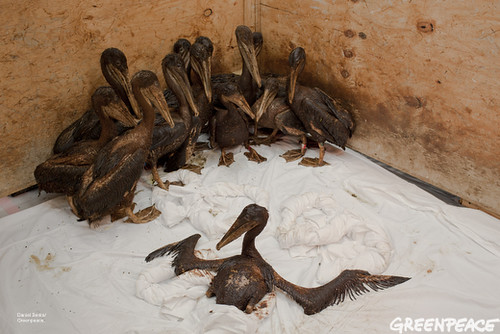
A group of baby brown pelicans, completely covered in oil, wait in a holding pen to be treated as part of the cleaning process at the Fort Jackson International Bird Rescue Research Center in Buras, Louisiana on June 20, 2010. Members of the Tri-State Bird Rescue and Research team work to clean birds covered in oil from the Deepwater Horizon wellhead. The BP leased Deepwater Horizon oil platform exploded on April 20 and sank after burning. Photo by © Daniel Beltra/Greenpeace.
IS IT ALL OVER YET?
WHEN CAN WE CLEAN UP
AND GO HOME
SEEING BP HAS CAPPED THE STUFF?


Monday, 28 June 2010
The word from Friends of the Earth on the dirty duck shooting deal and what to do about it
Friends of the Earth Melbourne
#52, June 2010
Dear friends,
Please find our occasional electronic bulletin below. Through this publication we aim to keep you updated on the progress of the Barmah-Millewa Campaign and how you can get involved.
The contents of this edition are:
1. Dirty Deal to Allow Duck Shooting in Murray River Park
2. Action Alert - Overturn the Dirty Duck Deal
If you are receiving this for the first time, it may be because you have recently subscribed yourself or given your email address at a FoE stall. If you don't want to receive this newsletter, many apologies: you can remove yourself by sending a message to barmahbulletin-unsubscribe@
Regards,
Jonathan La Nauze
for the Barmah-Millewa Collective
Friends of the Earth Melbourne
1. Dirty Deal to Allow Duck Shooting in Murray River Park
. Above: Duck-shooting in McDonald Swamp, northwest Victoria; An illegally shot native waterbird at the same location. Images by Noah Hannibalwww.duck.org.au/gallery | With Victoria's new Red Gum Parks to be officially proclaimed in ceremonies along the river tommorrow, we are very sorry to have to bring you some bad news. As reported in the Sunday Age yesterday, the Brumby Government has secretly promised duck hunters access to at least 40% of the 35,000 hectare Murray River Park despite promising parliament it would do the exact opposite. Allowing duck hunting in the Murray River Park will seriously jeopardise the ecological integrity of Victoria's new Red Gum Parks. Across the Murray-Darling Basin, native waterbird populations are in long-term decline due to pressures such as habitat loss and recreational hunting - exactly why the new Red Gum Parks are so important. It defies belief that the Brumby government would undermine its own policy in such a blatant way. Environment groups around the state cheered when Premier Brumby and his Environment Minister announced the Red Gum Parks in December 2008. A key element of park plan was the 35,000ha Murray River Park, connecting major national parks such as Barmah and Ovens and protecting thousands of critically important wetlands and billabongs along the river. The detail was tabled in parliament on March 10th, 2009 as the Formal Government Response to the VEAC River Red Gum Forests Investigation. It explicity stated that in the Murray River Park,"hunting and use of firearms" would not be permitted. Again, environment groups applauded the policy, as we did in November when the legislation finally passed. Meanwhile, it seems the government has been telling duck hunters something else. In a letter sent to hunting lobby groups the Sporting Shooters Association and Field & Game this March, Minister Jennings promised "40 per cent of the length of the Murray River Park will be available to duck hunters upon the proclamation of the park." The letter was obtained by the Victorian National Parks Association under Freedom of Information laws. Legally, the Minister has the power to permit duck hunting in the Murray River Park but doing so would be a blatant contradiction of what he told parliament and amounts to an extraordinary policy backflip. It will seriously undermine the Brumby government's conservation credentials only five months out from an election. |
2. Action Alert - Overturn the Dirty Duck Deal
Five months from an election in which the green vote is predicted to be critical, you'd think the Brumby government would be protective of its most significant conservation achievement. But Environment Minister Gavin Jennings has undermined all the hard work by promising to allow duck shooting in at least 40% of the vast Murray River Park before he has even launched it.
For the next two days Minister Jennings will be launching the new Red Gum Parks in ceremonies along the river, seeking to maximise media coverage of what on all other accounts is a terrific environmental and social justice achievement. You can bet his secret promise to the duck hunters won't feature highly in the media spin, so it's up to us to highlight the truth on talkback and in the letters pages:
774 MelbourneCall or SMS John Faine's morning program from 8:30 - 11am
Call - 1300 222 774
SMS - 19 774 774
The AgeEmail - letters@theage.com.au
Sunday AgeEmail - sunday@theage.com.au
Premier John Brumby
Email - john.brumby@parliament.vic.
Phone - (03) 9651 6255
It's not too late to undo this dirty deal. Premier Brumby must intervene and ban duck shooting in the Murray River Park as his government promised parliament it would do.
For more information on the impacts of recreational duck shooting, visit the theCoalition Against Duck Shooting website
About the Barmah-Millewa Collective
The Barmah-Millewa Collective shares a vision of healthy country, where biodiversity and bush tucker flourish; where the land, rivers and wetlands are clean and healthy; and where Traditional Owners enjoy their inherent rights to care for country and enjoy its produce.
In 2001 we joined the Yorta Yorta in their campaign to protect the world’s largest river red gum forest - Barmah-Millewa - from logging and cattle grazing, and negotiate a joint land management agreement with government. This campaign grew to cover the red gum forests along the length of the Murray and achieved a stunning victory in December 2008 with the announcement of 91,000ha of new red gum national parks in Victoria, and the co- management of the Barmah and Nyah Forests.
Building on this success, we now collaborate with Traditional Owner Nations throughout the Murray-Darling Basin to protect and care for this unique and threatened landscape. Our work ranges from on-ground revegetation projects through to campaigns for Aboriginal land rights and new conservation reserves.
Please support our workThe Barmah-Millewa Campaign relies on the generous support of everyday people like you.
If you are interested in volunteering with us please get in touch by emailingbarmah@foe.org.au
You can make a tax deductible donation from your credit card right now by visiting our website - just click here and follow the prompts.
Alternatively you can mail in a donation using credit card, cheque or money-order.Click here to download and print a donation slip (file in pdf format).
All donations over $2 are tax deductible. Thankyou for your support.
Contact Detailsemail: barmah@foe.org.au
phone: 9419 8700
visit/post: 312 Smith St/PO Box 222, Fitzroy, Victoria, 3065
web: www.melbourne.foe.org.au/?q=
Sunday, 23 August 2009
Bob Gosford from Yuendemu: birds and Aboriginal and Torres Strait Islands bird knowledge

Picture from here
Co-blogger and Networker, Denis, has sent me this information. He is being rather social to-day, he said when I asked him to post and write about it. After all, virtually every bit of knowledge I have (and I don't have much) about birds comes from Denis and his extent of knowledge and research which he demonstrates on his blog, The Nature of Robertson. In fact, if I may make so bold, TNOR is one of THE top nature blogs in Australia. And if you want to find the others, then check his sidebar.
Bob Gosford is known to a lot of us through his reporting on Aboriginal and political issues at Crikey. However, it turns out that birds are Bob's thing - and he is off on a marvellous and unique project. Can you help, dear Networkers?
From: bob gosfordTo: COG listSent: Saturday, August 22, 2009 11:01 PMSubject: [canberrabirds] Update - Aboriginal and Torres Strait Island Bird Knowledge projectDear COGgers,
Apologies for the lengthy post...
A quick note by way of an update on the Aboriginal & Torres Strait Island bird knowledge project I've been working on for - well, years now.
My initial interest in this topic was prompted by spending time with Aboriginal people soon after I moved to the Top End of the NT in the mid-eighties - it was soon apparent to me that Aboriginal people had a wealth of knowledge about the birds that they hunted and ate and celebrated in dance, song and art and that forms a rich thread running through their mythology, traditions and culture.
Fifteen years and a law degree and a temporary move to the south coast of NSW later I finally got to attend the post-grad certificate course at Charles Sturt University at the Thurgoona campus at Albury. There I asked lecturer, course coordinator and general all-round great guy Dr Dave Watson if he might have some thoughts about what to do about the apparent lack of appreciation of the knowledge and appreciation of Aboriginal bird knowledge by 'mainstream' (for want of a better term) birdwatchers and ornithologists.
Dave's answer was short and sweet - "Well Bob, if no-one else has done it you'd better do it yourself!". Little did I know what lay in store by my simple response that I'd do my best!
A telling fact that drove my interest in the early nineties was that the most substantial single source of Aboriginal bird knowledge in the mainstream ornithological literature was John Gould's "Handbook to The Birds of Australia", published in 1865. I've not been able to find a replacement candidate as the primary source - and much of the information contained therein was collected by one of Gould's collectors, John Gilbert, who was taken from us too soon in 1845 while on a cross-country expedition with Ludwig Leichhardt.
Anyway, eight years on from Dave's wise words I'm getting closer to producing my attempt at an overview of Aboriginal and Torres Strait Islander bird knowledge in a single volume. CSIRO Publishing will publish the book (with a tentative and somewhat boring working title of "Australian Aboriginal Bird Knowledge") in mid to late 2010 - dependent upon when I get the finished work to them.
One thing I do note is that it will not, indeed cannot, be a complete compendium of such knowledge - that would take more time and many more volumes than I have time for. But what I do hope is that it will start a broader interest and enquiry about local bird knowledge among the many distinct language groups and cultural blocs around the country - particularly in light of the growing importance of Aboriginal land management in many part of Australia.
I've spent a large part of the last five years (at least) collecting the literature - mainly from many hours in dusty (and not so dusty) libraries across Australia and across the globe (I've found some great works in libraries in Cambridge, Cape Town, Arkansas and New Orleans, to name a few), and have a stack - literally - of secondary research material.
What has occupied a large part of my time this year is organising and doing what I think will be the most important part of the book - travelling around the country talking to any Aboriginal person or group with an interest in taking part in my project. So far I've done a few trips up and down the NT - into the southern fringes of Arnhem Land - where I lived for a while in the eighties and nineties, around and to the west of Katherine and up and down the Stuart Highway.
I've also been into the east Kimberleys, South Australia (twice) and have just returned home here to Yuendumu (300 kilometres n-w of Alice Springs) from my latest trip that took me through eastern South Australia, coastal Victoria, southern and north-western NSW and central and western Queensland - a total of about 10,000 km.
In a week or so I'll take off up the Tanami Track via Balgo and surrounds, then back into the eastern Kimberley, across to Broome and then down to the Pilbara - then back along that same route - that should take me the best part of a month.
After a week or so at home I'm planning a route that will take me up the Stuart Highway to just south of Katherine, where I'll take the Central Arnhem Road via Wugularr, Bulman, Gapuwiyak to the heartlands of Yolngu culture around n-e Arnhem land. Then I hope to travel across through to Raminging and Maningrida in central Arnhem Land then back through Kakadu to Oenpelli and Jabiru. Depending on time and inclination I'll either swing towards Darwin or south via katherine and the Barkly, eventually ending up here at Yuendumu for a few days.
By then it should be sometime in early November and I'll turn my wheels eastward - if I'm lucky with time and weather I'd like to travel back into Queensland via the Plenty Highway - so much shorter, but rougher - than travelling via Tennant Creek and the Barkly) to Boulia - then back through s-w Queensland towards n-w NSW - eventually ending up in Walgett where I hope to spend some time again with the Dhariwaa Elders Group.
Then to the Australasian Ornithological Conference in Armidale in late November and early December. Then back through coastal northern NSW, up the coast to (about) Townsville then back across the NT and home.
That will be just about all of the field trips for this year - I have a couple of trips - by air - to Tasmania via Melbourne (to catch up on the excellent resources in the several libraries there) and then in mid- January hopefully to be in the Torres Strait islands about the same time that Dr Rohan Clarke from Monash Uni will be doing some field work there. And I may have a short road trip down to western South Australia and another up to the Gulf country.
And then - sitting down for a couple of months and putting it all together into some sort of shape that people - will want to read - and hopefully and more importantly - buy.
Finally, I've learned a lot about methodology for ethnobiology over the past that I hope to apply in a more specific PhD project looking at the application of local bird knowledge to local conservation and land management efforts here in the Tanami. And I'll be talking about methodology at AOC 2009 in Armidale and at the back-to-back conferences of the International Society of Ethnobiology and Society for Ethnobiology which will be held on the magnificent Vancouver island in British Columbia in May next year.
And by the way - if you are interested in having a look at a great set of posters in for central Australian languages have a look at the set of posters that my friend and colleague Myfany Turpin, of the University of Queensland and the Charles Darwin University School for Policy and Social Research has produced. The series of posters are of bird knowledge in the Arrernte, Anmatyerr, Alyawarr and Kaytetye languages spoken throughout central Australia.Individually they portray 25 or so birds found in the areas in which each language is spoken. As a set they reveal the depth of knowledge that Aboriginal people have of the birds that they hunt, share campsites and townships with and which are spiritually important or are involved in or related to traditional ceremonies and beliefs.
If you want any further information about my project please send an email tobirdknowledge@gmail.com and I'll be happy to send an Information Sheet or answer - as best I can - your queries. And please feel free to pass this email on to anyone you think might be interested in this project.
Cheers and I may see you on the road over the next few months.
Bob Gosford
Yuendumu, NT

Subscribe to:
Posts (Atom)