Showing posts with label Poetry. Show all posts

Wednesday, 23 March 2016

Dale Hess Calendar - March 21 2016


Thursday 31 March, 7 pm: Palestinian Poet Rafeef Ziadeh. Rafeef has received many accolades from leading lights in the arts such as Pulitzer-prize winning author and poet Alice Walker.  In fact, British filmmaker Ken Loach has said, ‘Rafeef's poetry demands to be heard.   She is powerful, emotional and political.  Please read her work and see her perform.  You cannot then be indifferent to the Palestinian cause.’ Kaleide Theatre, RMIT, 360 Swanston Street, Melbourne CBD. Rafeef will be joined by the indomitable singer/songwriter Phil Monsour, the album's producer, and the installation video and performance artist Aseel Tayah  known for her most glorious voice. Profits from the night will be donated to  Olive Kidsto assist Palestinian refugees in the Middle East. TICKETS AND BOOKINGS:  www.trybooking.com/180790. $ 22 to $29.


Tuesday 5 April, 6 pm: Black Mist, White Rain.  Featured speakers: Sue Coleman-Haseldine and Abaac Anjain-Maddison. Sue is a Kokatha-Mula woman living in Ceduna, South Australia. She was born at the Koonibba mission near Maralinga, a site of British nuclear testing. In December 2014 she travelled to Austria to deliver a testimony on the impacts of nuclear testing on Aboriginal land and people to 158 governments at the Vienna Conference on the Humanitarian Impact of Nuclear Weapons. Abacca was born on Rongelap, an island that will remain uninhabitable for generations due to radioactive contamination caused by nuclear testing conducted in the Pacific. For many people in Australia and the Pacific, nuclear weapons are not a distant, abstract threat, but a lived reality – a persistent source of pain and suffering, of contamination and dislocation. Indigenous communities bear the brunt of this ongoing scourge. Venue: Drill Hall, 26 Therry Street, Melbourne, VIC 3000.  The event is free but with limited space, so please register to ensure you get a seat. Book here. More information: www.icanw.org/au/bmwr. Contact Details: Gem Romuld - gem@icanw.org - 0421 955 066.


Thursday 7 April, 6 pm -  8.30 pm: Public Lecture: will terrorism and the ‘war on terror’ ever end? Prof. Joseph Camilleri will present a special lecture. The United States launched the war on terror at 9.30pm on September 11th 2001. Since then, over 61,000 terrorist attacks have killed more than 140,000 people. Many more have died in the wars in Afghanistan, Iraq, Syria and Libya. Many millions have had to flee their homes. Is there an end in sight to this mayhem?  Venue: St Michael's on Collins

120 Collins Street – Melbourne.


Sunday 10 April, 12.30 pm – 6 pm: Interfaith Film Festival. Different Books, Common Word - 1h (Muslim / Christian); Solomon & Gaenor [M]-  1h 42m (Jewish / Christian) ; Arranged [PG] - 1h 33 m (Muslim / Jewish). Cost $15 to cover expenses |  Further donations to JCMA welcome Light refreshments will be provided. Venue: AUSTRALIAN CATHOLIC UNIVERSITY  115 Victoria Parade, Fitzroy 3065 Christ Lecture Theatre (5); Mercy Lecture Theatre (6). Paid Parking available on Young Street.  RSVP by Monday 4 April 2016:  Eventbrite Bookings (preferred):  http://bit.ly/1JX9tSE; T: 03 9287 5590; M: 0400 211 221; Email:womenconference@jcma.org.au.


Monday 11 April; Sunday and Monday, 24 April and 25 April; Sunday 1 May: Ecological Literacy. Ecological literacy was initially used by David W. Orr and physicist Fritjof Capra in the 1990s, to understand the Earth as a living system whose well-being was dependent on our thinking in terms of the interdependence of all living systems. In his Web of Life Capra writes of the emergence of a new paradigm challenging the old mechanistic and linear view of the universe and challenging notions of continuous growth and development and with it consumerism and commodification as the “normal”. Ecological literacy is about using this interdependent view of the world to help address the complex dilemmas around the destructive impact that humans have had on the world bringing us to what is often called the Anthropocene… And together we'll draw on the experiences and wisdom of all participants, and the 'natural world' around us. Cost $800. Further details: info@oases.edu.au.


Tuesday, 12 April, 6 pm – 9 pm: Nuclear In/Justice. The Anti-Nuclear and Clean Energy Collectivepresents a new experiential workshop exploring the nuclear industry in a fun and participative way. We will go on a journey of movement and theatre to understand our role in the nuclear machine and work towards nuclear guardianship. Union House - Melbourne University, Parkville Campus, Melbourne, Victoria 3000, Australia. Google map and directions. This is a free event. RSVP’s essential. Contact: Jemila Rushton:jemila.rushton@gmail.com. 


Wednesday 13  April, 6.45 pm: Rare screening of On the Waterfront.  Transparency International Australia’s Victorian Chapter presents a screening of the film On the Waterfront. Set against the Waterfront Crime Commission (1953), this film has everything: the mob, murder, corruption, social justice and a love story. See a young Marlon Brando struggle with the difficulty of making moral choices in an uncertain modern world. The film endures as a powerful observation of both society and humanity, resonating for audiences as much today as when it was made in 1954. It swept the Academy Awards in the year of its release. An introduction to the film will be made by Phil Newman (CEO of Transparency International Australia) and Tricia Caswell (former union leader & ACTU Executive Member). Phil will highlight TI Australia's work and Tricia will reflect on her experience in the union movement. Book your ticket here. Pls help us make this inaugural film night a success by inviting your friends by forwarding this email, or posting info on to your Facebook, Linkedin or other social media sites. Where: ACMI Cinema 1, Federation Square.Cost: $20 ($15 concession)


Monday 25 April – Friday 29 April: Living the Peace Testimony with Greg Rolles. Explore the connections between war, militarism, climate change, colonisation of Indigenous peoples, racism – and your own urges to help bring peace. 
Silver Wattle Quaker Centre, 
1063 Lake Road, Bungendore, NSW. 
Telephone:02 6238 0588


Tuesday 26 April, 6.30 pm – 10 pm: Remembrance and Resilience: 30 Years after Chernobyl. TheAnti-Nuclear and Clean Energy Collective and the Medical Association for the Prevention of War (MAPW) present a night of short films and talks to remember the Chernobyl disaster and to celebrate the ongoing resistance to the nuclear industry. Joining us will be a special guest speaker, Bill Williams from MAPW. Films to be confirmed. Venue: Loop Project Space and Bar, 23 Meyers Place, Melbourne, VIC 3000
Google map and directions. Contact: ace@foe.org.au. $10/$15 solidarity.


Sunday 22 May, 6 pm: An Evening with Edward Snowden. The Castan Centre for Human Rights Law is proud to be supporting Edward Snowden's first ever (virtual) speaking tour in Australia, presented by Think, Inc. Join us to hear Snowden comment on the dangers of Australia's growing governmental surveillance, the tumultuous relationship between individualism and 'national security', and on the actions that polarised him as a paladin for the public and a public enemy to politicians. (Appearing via a video link). The Plenary – Melbourne Convention Centre, 1 Convention Centre Place, Melbourne. For tickets click here.


Friday 10 June – Monday 13 June: Indigenous Spirituality and Culture with Karen Kime. Journey into Aboriginal ways of teaching country, kinship and cross-cultural issues in work and community. The workshop will also include examples of other indigenous people. Silver Wattle Quaker Centre, 1063 Lake Road, Bungendore, NSW. Telephone:02 6238 0588


Monday 11 July; Sunday and Monday, 31 July and 1 August; Saturday 10 September: Recreating our Organisations. We live in a world of organisations, educational, familial, work…each with its own culture and processes and each creating its own set of experiences for those who interact with it. Whilst we cannot escape from the reality of organizations in our lives, we can learn to better understand, work with and change (for the better) the organizations in which we play a part…In this unit then our central question addresses the possibilities of recreating or re-imagining the way we organise that would create more soulful, meaningful, value based,  collaborative and generative organisations that are relevant for 21st century sustainable and socially just organisations. Cost $800. Further details: info@oases.edu.au.


 Friday 21 October – Saturday 22 October: The Justice Conference. The 2016 Justice Conference has a brilliant line up of international and Australian speakers, thinkers and practitioners. With two full days of content, including key note sessions, worship, poetry, panels, electives and glimpses of justice, there is no doubt that you will be challenged and inspired. Stay tuned for more information regarding the program as we near the conference. Venues: Melbourne Town Hall and Atheneaum Theatre. Further details:http://www.thejusticeconference.com.au/

Saturday, 25 April 2015

Lest We Forget - a pacifist's remembrance of the centenary of ANZAC Day - Part 1


When one thinks of anti-war poetry, 
more often than not it is the poetry of World War 1, 
of the horrendous battlefields of the Western Front
of the poetry of Siegfried Sassoon and Wilfred Owen. 
Wilfred Owen is the author of what may be the best known anti-war poem,
Dulce et Decorum Est
Please go here for Dr Andrew Barker's analysis of Dulce et Decorum Est

As I write this, on the centenary of the landing at Gallipoli, thousands of Australians have left their homes to attend Dawn Services across the country, to keep alive the ANZAC tradition.  Other thousands of Australians have left their homeland to commemorate the Australian war dead in Turkey and France.  I have chosen to stay at home and write this reflection.

My own commemoration was done on Thursday night as I watched on television Kate Aubusson's wonderful remembrance, Lest We Forget What?.  Kate's film is the best thing I have seen or read about our ANZAC tradition - the research done, the people featured in the film, the things we didn't know and which are seldom revealed.  

I think this day on the war-time service of the men in my family - especially of the one who didn't return home, my great uncle Claude Gallaway.  He perished on the Western Front in France.  He was 26 years old.  Through the Australian War Memorial records we have been able to see the heart-breaking letters written regularly to the powers-that-be from my great grandmother and my three great aunts reminding them that their son and brother was still missing.

My grandfather, Jack (Rupert Franklin Gore) Gallaway, and his brother William Gallaway were Lighthorsemen. 

In World War 2, my uncle Roland Gore Gallaway served as a Coastwatcher on Manus Island and later in Japan with the Occupation Forces. My uncle, Jack Franklin Gallaway, served in the Royal Australian Navy in World War 2 and in Korea. Jack wrote The Last Call of the Bugle: Kapyong, Korea.  The title of the book refers to Korea being the last Australian conflict for which the call went out for volunteers.

My father, John Joseph (Jack) O'Carroll, served in Malaya in the 2/10th Field Regiment of the Eighth Division.  He was invalided home six weeks before the fall of Singapore.

For my generation, Vietnam was an issue and a horror.  It was then I became a pacifist. I have seen no reason in the decades since to resile from this decision.

Across history we have seen one conflict begetting another. World War 1 begat World War 2.  The American invasion of Iraq in recent decades has certainly influenced the current violence in the Middle East. There is the history of foreign military involvement in Afghanistan.  In recent generations, we have developed the so-called proxy wars. Australia is becoming enmeshed in these wars of empire.

I believe that pacifists fulfill the slogan we say each Anzac Day.  We are there to remind people of the cost, the horror, the futility of war ... Lest We Forget.


"They shall grow not old, as we that are left grow old;
Age shall not weary them, nor the years condemn.
At the going down of the sun and in the morning
We will remember them."

Lest We Forget.

Monday, 2 December 2013

Eureka Day, 3 December - Geraldine Robertson gives insight into women and Eureka - Susan Kruss in Calico Ceilings expresses her respect for women at Eureka in history poetry, and drawings - and women are involved in M.A.D.E.


wmnsweb@iprimus.com.au


Dear All,

3rd December is the 159th anniversary of the Eureka Stockade. 

Are those of our foremothers who were on the goldfields to be remembered just as token 'them' who were 'assisted to find a job' as the Australian Government website on Eureka states?

Are not we 'the people' too?

I think it is outrageous, so have been busy compiling a response.
I hope you like and find good use for EUREKA? We Were There.
It is on a new page called Eureka on www.womensweb.com.au Eureka page.
I hope you have a joyful and relaxing holiday season,
Geraldine
'The peoples, as well as the Governments, have sown the wind of misunderstanding and of hate and are reaping the whirlwind ...
'We MUST not, DARE not, be idle.'
Woman Voter 18 December 1919
‘History will proclaim you false if you are silent now. “Come out and be separate” from all that makes for war.’
Woman Voter 29 September 1914
Geraldine Robertson
Tel: 03 9486 1808 Mobile: 0410 514 034
wmnsweb@iprimus.com.au
Women's Web - Women's Stories, Women's Actions www.womensweb.com.au
Prejudice and Reasonwww.prejudiceandreason.com.au
Women Working Together suffrage and onwardswww.womenworkingtogether.com.au
Vasculitis the Disease that Deceiveshttp://www.vasculitis.net.au
Betrayal women's paid work 1874-1974http://home.vicnet.net.au/~betrayal
Our Foremothershttp://home.vicnet.net.au/~mothers


Calico Ceilings by Susan Kruss
A wonderful look at women at Eureka
Beautifully illustrated.
Insightful poems.

Postscript:
Women are still at Eureka.

This year the Museum of Australian Democracy at Eureka (M.A.D.E.) opened in Ballarat on the historic Eureka site.  It is a wonderful small museum.  It is not limited to the Eureka story and the events surrounding Australia's famous rebellion.

As well as Eureka, M.A.D.E. also centres on social justice, democracy, and human rights which topics were seminal to the idea of the Eureka Rebellion even if they were not fully articulated at the time.  These ideas took hold in the Australian psyche through workers rights, universal suffrage, and a fair go for everyone.  And a woman is in charge at M.A.D.E.  


M.A.D.E Director Jane Smith interviews 
the M.A.D.E Project Director, Katherine Armstrong of Lateral Projects, 
and M.A.D.E Curator, Eithne Owens, 
on the thinking and process that led to the birth of Australia's newest museum.

Museum of Democracy at Eureka (M.A.D.E)
http://www.made.org

Monday, 2 September 2013

Melbourne Free University - Gender wars - Poetry - Media Ethics;


There's a lot on at the MFU this week.

On Tuesday (3/10) Gender Wars continues with Bombshells, a discussion of nuclear disarmament, Australian anti-war movements and the role of women and minorities in times of war and protest. Our panellists this week are Geraldine Robertson (Women's Web), Dimity Hawkins (ICAN/Reaching Critical Will) and Carole Wigg (Medical Practitioners for the Prevention of War).  6.30-8pm at Some Velvet Morning, 123 Queens Pde Clifton Hill.

Do you read poetry?  On Wednesday (4/10) Bonnie Cassidy (Deakin/RMIT) talks about why she does.  Like a virus or an annoying ex-lover, poetry persists: in Australia alone, there are over a dozen independent poetry publishers, and in Melbourne, at least twenty regular events for its live performance. But why keep poetry in our lives when we have novels, films and virtual fun; can it make something else happen? Exploring provocative poems from very different times and places, this seminar is for anyone curious about why and how we read.  6.30-8pm at The Alderman, 134 Lygon St, E. Brunswick.

And on Thursday (5/10) our course on Media Ethics turns to the ethics of disaster reporting withMutiny Media director, Nicholas Hansen. The disaster zone is a vortex of information, much of it spun out by first responders to a hungry media. The public has a right to know, but where is actuality amongst these hurried impressions and in whose interest is the news we receive? We'll be discussing the factors that influence contemporary disaster reporting, and issues around its consumption. How are ethics stretched in production and reception, and where are the opportunities as media speeds up and our capacity increases to talkback?  6.30-8pm at The Alderman, 134 Lygon St, E. Brunswick.

We've added some great speakers to our current courses, so check out the attached flyer for full details of what's coming up in the next 4 weeks.

Hope to see you there!

the MFU

Thursday, 1 August 2013

Our crisis - Asylum Seekers and Refugees - but we have a choice on election day. Read this and please vote accordingly.


'Our Crisis'

You let them cry
With no sympathy
You let them die
With no dignity
You trade their lives
For popularity
You trade their rights
Like they’re property

You paint them as animals
They've bled as humans
You lock them in jail cells
Silencing innocence
You treat them as criminals
They're your wars' victims
They re-live their hell
When they need protection

You condemn their persecutors
You persecute them too
They're not our crisis
Our crisis is you.

- Anonymous


Monday, 29 April 2013

How do I loathe the IPA? Let me count the ways. With apologies to Elizabeth Barrett Browning


How do I loathe the IPA? Let me count the ways.
I loathe thee to the depth and breadth and height
My soul can reach, when feeling you in sight.
For the ends of Being and ideal Grace,
I know you never understand.
Most quiet need, by sun and candle-light, but you the gloom.
I loathe thee freely, as your people strive for The Right;
I loathe thee purely, as Tim Dunlop mans The Drum.
I loathe thee with a passion put to use
Remembering old equalities, and with a community’s faith.
I loathe thee with a loathing I can’t lose
Amid your warped ideal, --- I loathe thee with the breath,
Smiles, tears, of all my life! --- and, if God choose,
I shall but loathe thee better after death.
With apologies to Elizabeth Barrett Browning.

Sunday, 1 January 2012

The Gate of the Year

This post was originally published on The Trad Pad on  2 January 2011.  Happy New Year everyone ... particularly to those who did it tough this year.  Please take on board the thoughts of Minnie Louise Haskins
~~~~~~

Happy New Year! May the year be kind to you and bring you blessings, wisdom, peace, and prosperity!  The last day or two has exhibited some coincidence. Firstly, Hay Quaker published, in toto, the poem The Gate of the Year by Minnie Louise Haskins.
Minnie Louise Haskings - The gate of the year
 Minnie Louise Haskins
I said to the man who stood at the gate of the year,
"Give me a light that I may tread safely into the unknown."
And he replied, "Go into the darkness and put your hand into the hand of God.
That shall be to you better than light and safer than a known way!"
So I went forth and finding the Hand of God
Trod gladly into the night.
He led me towards the hills
And the breaking of day in the lone east.
So heart be still!
What need our human life to know
If God hath comprehension?
In all the dizzy strife of things
Both high and low,
God hideth his intention.
Perhaps readers have heard this poem, or part of it, before.  It was made famous by the Christmas Speech of King George VI delivered in 1939.  You can hear the actual speech – it is quite moving given it is made at the time of the first Christmas of World War II – here.
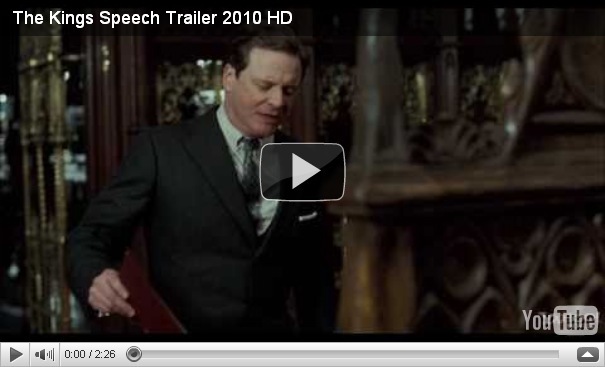
the-kings-speech -the movie
Secondly, I decided to get out of the house for the first time since  Christmas Midnight Carols and Eucharist at All Saints, Mitcham and go to see the much lauded movie, The King’s Speech. It is the story of the relationship between the Australian speech therapist, Lionel Logue, and King George VI.


The movie is being tipped as a frontline contender for an Oscar. In spite of competition from The Social Network in the bookies’ odds as set out here, it is hard to see how this movie could lose with its high proportion of former Academy Award winning actors.  The UK still produces the best actors – particularly in ensemble work as demonstrated in The King’s Speech – in the English speaking world.  However, it does an Australian heart good – particularly one coming from Queensland – to see and hear Geoffrey Rush mixing it admirably with such a talented cast. To think, this great man of Australian movies was growing up across Brisbane from me in the 1950s!
Those sitting around me in the packed movie theatre were clearly as impressed as I. 
I was however surprised at the ending. I don’t think, in such an historical movie, it is giving away much to describe the ending of this movie.  I thought the movie somehow would finish with the 1939 Christmas Speech. This is arguably the most famous, most remembered, and most quoted of all the King George VI’s speeches.  This doesn’t happen.  The movie concludes with the King’s Speech at the beginning of World War II.

Thursday, 25 November 2010

Mourning for the Pike River miners


The New Zealand flag flies at half-mast

Hearts full of sympathy and love go out to the relatives.
Gratitude and sympathy goes to those involved in the
planning for rescue and those who will be involved in finding and telling
the true story of what happened below ground at Pike River.
Enhanced by Zemanta

Total Pageviews